
200-301 · Question #1476
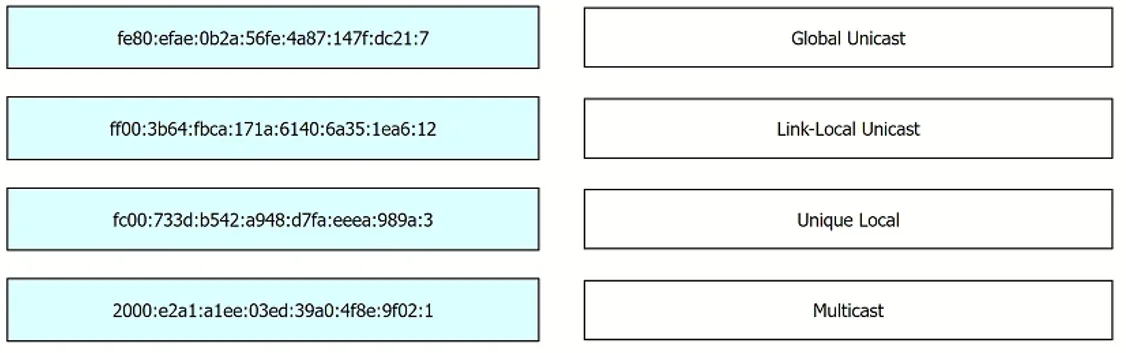
Drag and Drop Question Drag and drop the IPv6 address from the left onto the type on the right. Answer:
The correct answer is 2000:e2a1:a1ee:03ed:39ad:4f6e:9f02:1; fe80::efae:0b2a:56fe:4a87:147f:dc21:7; fc00:733d:b542:a948:d7fa:ecea:989a:3; ff00:3b64:fbca:171a:6140:6a35:1ea6:12. IPv6 Address Type Classification The question asks you to match each IPv6 address to its address type. The four types (implied by the arrangement) are: | Position | Type | Address | |----------|------|---------| | 1 | Global Unicast | 2000:e2a1:... | | 2 | Link-Local |…
Question
Drag and Drop Question Drag and drop the IPv6 address from the left onto the type on the right. Answer:
Exhibit
Answer Area
Drag items
Correct arrangement
- 2000:e2a1:a1ee:03ed:39ad:4f6e:9f02:1
- fe80::efae:0b2a:56fe:4a87:147f:dc21:7
- fc00:733d:b542:a948:d7fa:ecea:989a:3
- ff00:3b64:fbca:171a:6140:6a35:1ea6:12
Explanation
IPv6 Address Type Classification
The question asks you to match each IPv6 address to its address type. The four types (implied by the arrangement) are:
| Position | Type | Address |
|---|---|---|
| 1 | Global Unicast | 2000:e2a1:... |
| 2 | Link-Local | fe80::efae:... |
| 3 | Unique Local | fc00:733d:... |
| 4 | Multicast | ff00:3b64:... |
Item-by-Item Breakdown
1. 2000:e2a1:a1ee:03ed:39ad:4f6e:9f02:1 -> Global Unicast
- Starts with
2000- falls within the2000::/3prefix (first 3 bits =001) - These are publicly routable addresses, equivalent to public IPv4 addresses
- All Global Unicast addresses start with
2or3
2. fe80::efae:0b2a:56fe:4a87:147f:dc21:7 -> Link-Local
- Starts with
fe80- falls withinfe80::/10 - Valid range:
fe80::throughfebf::(thoughfe80is the only prefix used in practice) - Automatically assigned on every IPv6 interface; not routable beyond the local network segment
- The
::compression is a clue - link-local addresses often have long zero runs
3. fc00:733d:b542:a948:d7fa:ecea:989a:3 -> Unique Local
- Starts with
fc- falls withinfc00::/7(coversfc00::tofdff::) - Equivalent to RFC 1918 private addresses (10.x, 172.16.x, 192.168.x) in IPv4
- Routable within an organization but not on the public internet
- Common mistake: confusing
fc00::/7withfe80::/10(link-local) - they're different ranges
4. ff00:3b64:fbca:171a:6140:6a35:1ea6:12 -> Multicast
- Starts with
ff- falls withinff00::/8 - All IPv6 multicast addresses begin with
ff; there is no broadcast in IPv6 - multicast replaces it - Common mistake: IPv6 has no broadcast -
ffis always multicast, never broadcast
Common Mistakes
- Confusing Link-Local (
fe80) and Unique Local (fc/fd): Both are non-routable externally, but they serve different purposes. Link-local is per-link only; unique local works across an organization's internal network. - Forgetting
2and3are both Global Unicast: The2000::/3block includes addresses starting with2or3. - Assuming
ffmeans broadcast: IPv6 eliminated broadcast entirely -ffis always multicast.
Topics
Community Discussion
No community discussion yet for this question.