
200-301 · Question #1474
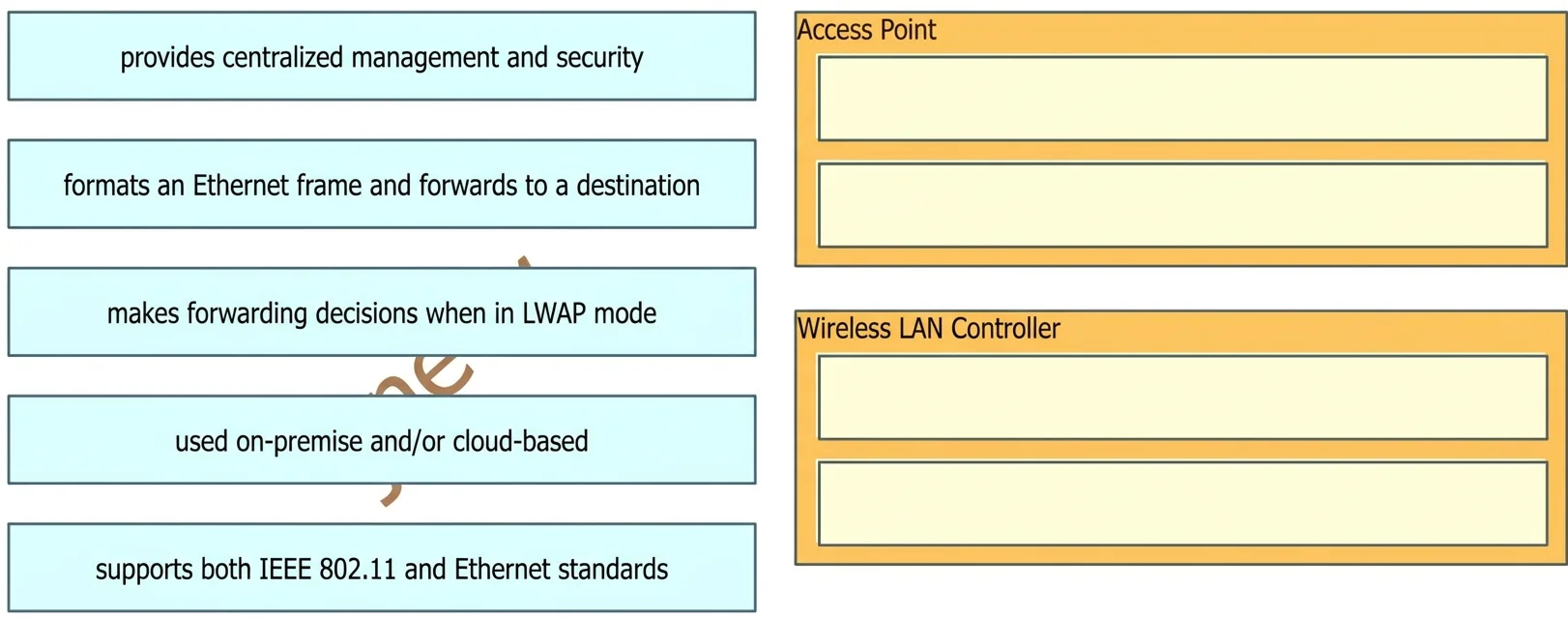
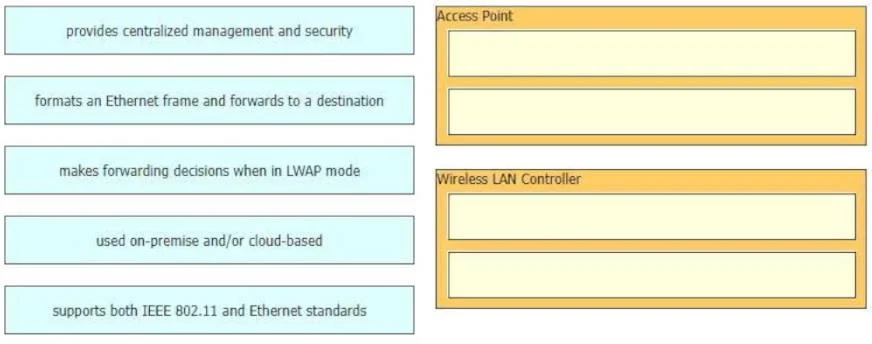
Drag and Drop Question Drag and drop the characteristic from the left onto the device type on the right Not all characteristics are used. Answer:
The correct answer is formats an Ethernet frame and forwards to a destination; supports both IEEE 802.11 and Ethernet standards; provides centralized management and security; used on-premise and/or cloud-based. The correct arrangement maps characteristics to specific device types in a wireless networking context: an Access Point (AP) in autonomous mode formats Ethernet frames and forwards them to destinations while also supporting both IEEE 802.11 (wireless) and Ethernet (wired)…
Question
Exhibits
Answer Area
Drag items
Correct arrangement
- formats an Ethernet frame and forwards to a destination
- supports both IEEE 802.11 and Ethernet standards
- provides centralized management and security
- used on-premise and/or cloud-based
Explanation
The correct arrangement maps characteristics to specific device types in a wireless networking context: an Access Point (AP) in autonomous mode formats Ethernet frames and forwards them to destinations while also supporting both IEEE 802.11 (wireless) and Ethernet (wired) standards, bridging the two media types. A Wireless LAN Controller (WLC) provides centralized management and security for lightweight APs and can be deployed on-premise and/or in the cloud (such as Cisco DNA Center or cloud-managed solutions like Meraki). The distractor 'makes forwarding decisions when in LWAP mode' is incorrect because it is the WLC - not the AP - that makes forwarding decisions when APs operate in Lightweight Access Point (LWAP) mode, making this option a plausible but inaccurate description for either device as a standalone characteristic.
Topics
Community Discussion
No community discussion yet for this question.