
200-301 · Question #1449
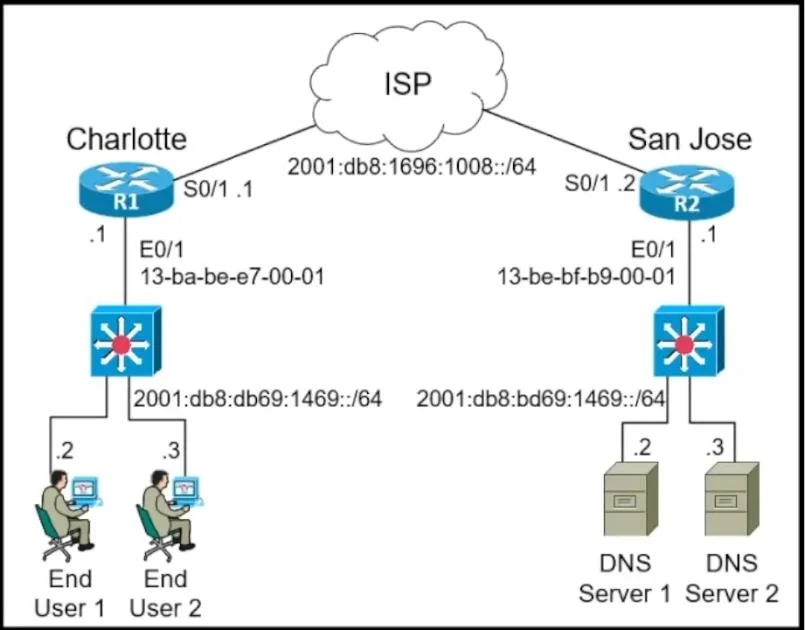
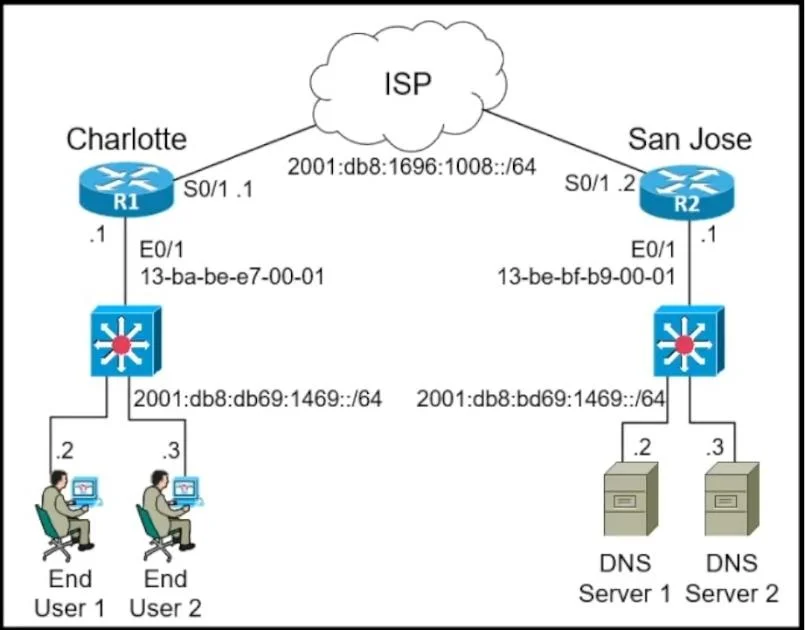
Refer to the exhibit The IPv6 address for the LAN segment on router R2 must be configured using the EUI-64 format. When configured which ipv6 address is produced by the router?
The correct answer is D. 2001:db8:bd69:1469:11BE:BFFF:FEB9:1. An IPv6 EUI-64 address is derived from a 48-bit MAC address by inserting 'FFFE' in the middle and inverting the 7th bit of the first octet.
Question
Refer to the exhibit The IPv6 address for the LAN segment on router R2 must be configured using the EUI-64 format. When configured which ipv6 address is produced by the router?
Exhibits
Options
- A2001:db8:bd69:1469:12D8:BAFE:FF01:1
- B2001:db8:bd69:1469:1130:ABFF:FECC:1
- C2001:db8:bd69:1469:4628:255F:FE32:1
- D2001:db8:bd69:1469:11BE:BFFF:FEB9:1
How the community answered
(38 responses)- A8% (3)
- B5% (2)
- C16% (6)
- D71% (27)
Why each option
An IPv6 EUI-64 address is derived from a 48-bit MAC address by inserting 'FFFE' in the middle and inverting the 7th bit of the first octet.
This address does not follow the correct EUI-64 format as the 'FFFE' insertion and bit-flip logic are not consistently applied.
This address would be generated from a different MAC address and/or an incorrect application of the EUI-64 bit-flipping rule, leading to an incorrect prefix and interface ID.
This address would be generated from a different MAC address and/or an incorrect application of the EUI-64 bit-flipping rule, resulting in an incorrect prefix and interface ID.
Assuming the router's interface MAC address from the exhibit was '10BE.BFB9.0001' (10:BE:BF:B9:00:01), EUI-64 conversion splits the MAC into '10:BE:BF' and 'B9:00:01'. It then inserts 'FFFE' in the middle, resulting in '10BE:BFFF:FEB9:0001'. Finally, the 7th bit (the Universal/Local bit) of the first octet ('10', binary 00010000) is flipped from 0 to 1, changing '10' to '11' (binary 00010001), yielding the IPv6 interface ID '11BE:BFFF:FEB9:1'.
Concept tested: IPv6 EUI-64 address formation
Source: https://www.cisco.com/c/en/us/td/docs/ios-xml/ios/ipv6/configuration/xe-3s/ipv6-xe-3s-book/ip6-eui64-fmt.html
Topics
Community Discussion
No community discussion yet for this question.