
200-301 · Question #1380
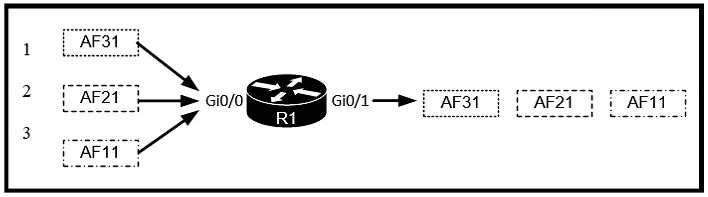
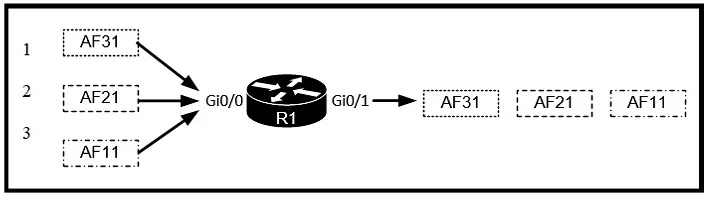
Refer to the exhibit. Which per-hop QoS behavior is R1 applying to incoming packets?
The correct answer is C. queuing. Queuing is a per-hop QoS behavior where incoming packets are buffered and scheduled for transmission based on specific algorithms, managing congestion on an interface.
Question
Refer to the exhibit. Which per-hop QoS behavior is R1 applying to incoming packets?
Exhibits
Options
- Amarking
- Bshaping
- Cqueuing
- Dpolicing
How the community answered
(56 responses)- A5% (3)
- B16% (9)
- C75% (42)
- D4% (2)
Why each option
Queuing is a per-hop QoS behavior where incoming packets are buffered and scheduled for transmission based on specific algorithms, managing congestion on an interface.
Marking is the act of classifying packets by adding a QoS tag (e.g., CoS, DSCP) to them, which typically occurs earlier in the QoS process and isn't the direct per-hop behavior of handling packets for transmission.
Shaping buffers excess traffic and smooths the output rate to a configured value, typically applied to outgoing traffic over a period, rather than the immediate per-hop handling of incoming packets.
Queuing is a fundamental per-hop QoS mechanism that involves placing packets into different queues based on their classification and then scheduling their transmission according to a configured algorithm, directly influencing how traffic is handled to mitigate congestion.
Policing enforces a maximum rate by dropping or re-marking packets that exceed the threshold, which is about enforcing limits rather than the general per-hop behavior of packet scheduling and management.
Concept tested: Per-hop QoS behaviors (queuing)
Source: https://www.cisco.com/c/en/us/td/docs/ios-xml/ios/qos_congest/configuration/xe-16/qos-congest-xe-16-book/qos-queuing.html
Topics
Community Discussion
No community discussion yet for this question.