
200-301 · Question #1320
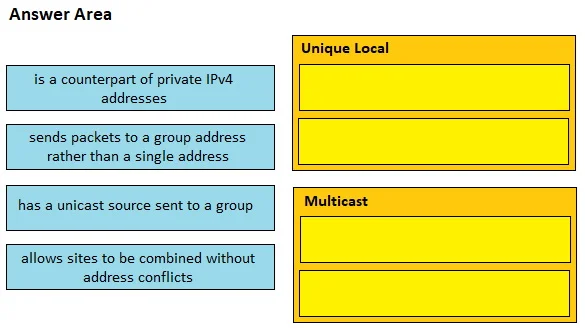
Drag and Drop Question Drag and drop the characteristic from the left onto the IPv6 address type on the right. Answer:
The correct answer is Global Unicast; 2000:87aa:84ab:fdd9:5ac3:41a5:ef72:1; Link-Local Unicast; fe80::ccc7:17f1:5d15:f611:5cea:ef92:7; Multicast; ff00:520a:3e47:de13:fe6f:476e:5325:12; Unique Local; fc00:c51f:922d:0c12:9c:54:7644:2ff5:3. IPv6 Address Type Identification - Explanation IPv6 address types are identified by their prefix (the leading bits/hex digits). This is the key to matching each address correctly. --- 1. Global Unicast -> 2000:87aa:84ab:fdd9:5ac3:41a5:ef72:1 Prefix: 2000::/3 - addresses…
Question
Exhibit
Answer Area
Drag items
Correct arrangement
- Global Unicast
- 2000:87aa:84ab:fdd9:5ac3:41a5:ef72:1
- Link-Local Unicast
- fe80::ccc7:17f1:5d15:f611:5cea:ef92:7
- Multicast
- ff00:520a:3e47:de13:fe6f:476e:5325:12
- Unique Local
- fc00:c51f:922d:0c12:9c:54:7644:2ff5:3
Explanation
IPv6 Address Type Identification - Explanation
IPv6 address types are identified by their prefix (the leading bits/hex digits). This is the key to matching each address correctly.
1. Global Unicast -> 2000:87aa:84ab:fdd9:5ac3:41a5:ef72:1
Prefix: 2000::/3 - addresses starting with binary 001, covering the hex range 2000:: through 3FFF::.
This address starts with 2000, placing it squarely in the global unicast range. These are the publicly routable addresses on the internet - the IPv6 equivalent of public IPv4 addresses.
Common mistake: Confusing global unicast with unique local because both sound "global." Global unicast = publicly routable; unique local = private/internal only.
2. Link-Local Unicast -> fe80::ccc7:17f1:5d15:f611:5cea:ef92:7
Prefix: FE80::/10 - addresses starting with FE80 through FEBF.
This address starts with fe80, the universally recognized link-local prefix. These addresses are automatically assigned to every IPv6 interface and are only valid on the local network segment - they are never routed.
Common mistake: Thinking FE80 is just one of many possible link-local prefixes. In practice, virtually all link-local addresses use exactly FE80::/64 (the remaining bits of the /10 range are reserved/unused).
3. Multicast -> ff00:520a:3e47:de13:fe6f:476e:5325:12
Prefix: FF00::/8 - any address beginning with FF.
The ff first byte is the unmistakable multicast identifier. These addresses represent a group of interfaces that subscribe to receive traffic sent to that address. IPv6 replaces broadcast entirely with multicast.
Common mistake: Confusing multicast (FF00::/8) with unique local (FC00::/7) because both start with F. The second hex digit distinguishes them: FF = multicast, FC/FD = unique local.
4. Unique Local -> fc00:c51f:922d:0c12:9c:54:7644:2ff5:3
Prefix: FC00::/7 - addresses starting with FC00 through FDFF.
This address starts with fc00, placing it in the unique local range. These are the IPv6 equivalent of RFC 1918 private addresses (like 192.168.x.x). They are not globally routable but can be used freely within an organization.
Common mistake: Confusing unique local with link-local. Unique local (FC/FD) can be routed within an organization across multiple subnets; link-local (FE80) cannot leave the local segment at all.
Quick Reference Cheat Sheet
| Prefix | Type |
|---|---|
2000::/3 (2000-3FFF) | Global Unicast |
FC00::/7 (FC00-FDFF) | Unique Local |
FE80::/10 (FE80-FEBF) | Link-Local Unicast |
FF00::/8 (FF00-FFFF) | Multicast |
The exam tests whether you can read the first 1-2 bytes of an address and map them to these ranges - no calculation required, just prefix recognition.
Topics
Community Discussion
No community discussion yet for this question.