
200-301 · Question #1309
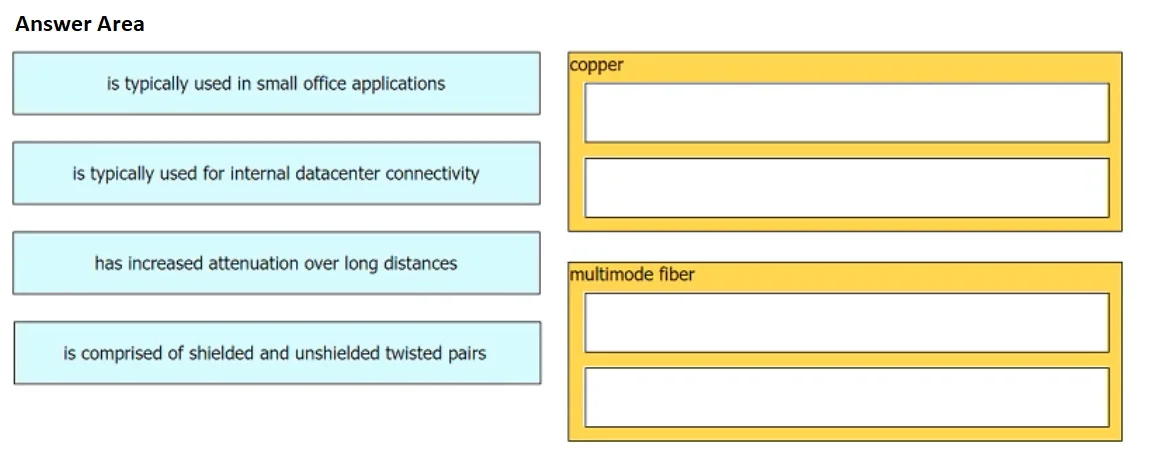
Drag and Drop Question Drag and drop the characteristic from the left onto the cable type on the right. Answer:
The correct answer is is typically used in small office applications; is comprised of shielded and unshielded twisted pairs; is typically used for internal datacenter connectivity; has increased attenuation over long distances. The correct arrangement maps each characteristic to its corresponding cable type based on standard networking knowledge. UTP (Unshielded Twisted Pair) is typically used in small office applications due to its low cost and ease of installation. STP (Shielded Twisted Pair) is…
Question
Drag and Drop Question Drag and drop the characteristic from the left onto the cable type on the right. Answer:
Exhibit
Answer Area
Drag items
Correct arrangement
- is typically used in small office applications
- is comprised of shielded and unshielded twisted pairs
- is typically used for internal datacenter connectivity
- has increased attenuation over long distances
Explanation
The correct arrangement maps each characteristic to its corresponding cable type based on standard networking knowledge. UTP (Unshielded Twisted Pair) is typically used in small office applications due to its low cost and ease of installation. STP (Shielded Twisted Pair) is comprised of both shielded and unshielded twisted pairs, providing better EMI protection. Fiber optic cable is typically used for internal datacenter connectivity due to its high bandwidth and low latency. Coaxial cable has increased attenuation over long distances compared to modern alternatives, which limited its use in legacy networks.
Topics
Community Discussion
No community discussion yet for this question.