
200-301 · Question #1129
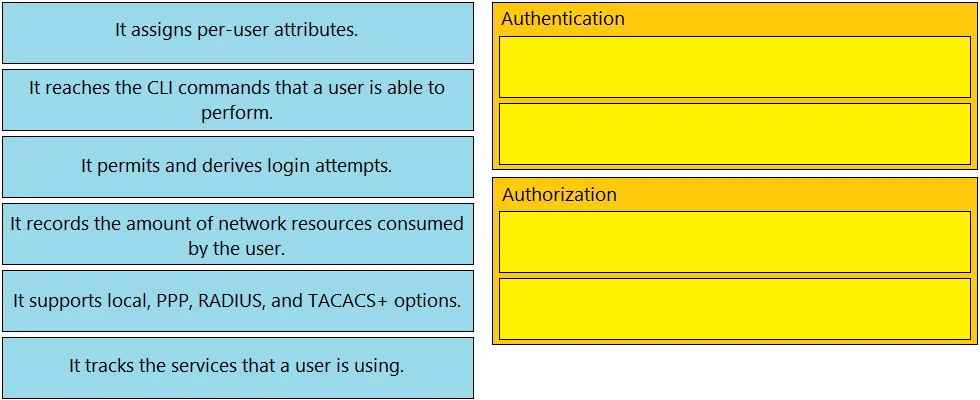
Drag and Drop Question Drag and drop the statements about AAA from the left onto the corresponding AAA services on the right. Not all options are used. Answer:
The correct answer is It permits and derives login attempts.; It supports local, PPP, RADIUS, and TACACS+ options.; It assigns per-user attributes.; It reaches the CLI commands that a user is able to perform.; It records the amount of network resources consumed by the user.; It tracks the services that a user is using. AAA stands for Authentication, Authorization, and Accounting. Authentication 'permits and derives login attempts' and 'supports local, PPP, RADIUS, and TACACS+ options' - it verifies who the user is using various methods. Authorization 'assigns per-user attributes' and 'reaches…
Question
Exhibit
Answer Area
Drag items
Correct arrangement
- It permits and derives login attempts.
- It supports local, PPP, RADIUS, and TACACS+ options.
- It assigns per-user attributes.
- It reaches the CLI commands that a user is able to perform.
- It records the amount of network resources consumed by the user.
- It tracks the services that a user is using.
Explanation
AAA stands for Authentication, Authorization, and Accounting. Authentication 'permits and derives login attempts' and 'supports local, PPP, RADIUS, and TACACS+ options' - it verifies who the user is using various methods. Authorization 'assigns per-user attributes' and 'reaches the CLI commands that a user is able to perform' - it controls what authenticated users are allowed to do. Accounting 'records the amount of network resources consumed by the user' and 'tracks the services that a user is using' - it logs user activity for auditing and billing purposes.
Topics
Community Discussion
No community discussion yet for this question.