
200-301 · Question #1089
Drag and Drop Question Drag and drop the RF terms from the left onto the corresponding statements on the right. Answer:
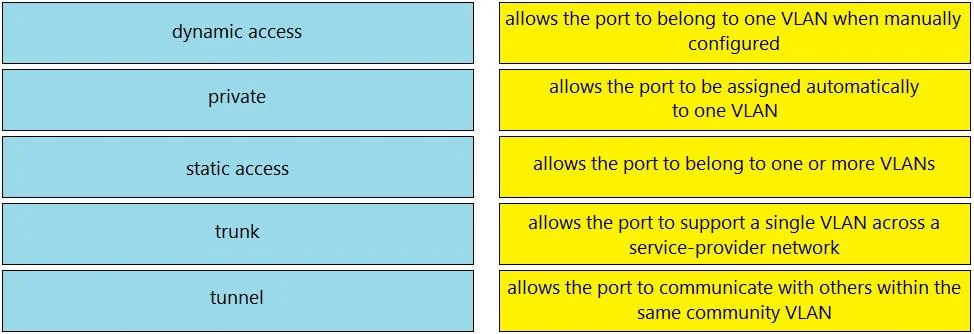
The correct answer is static access; dynamic access; trunk; tunnel; private. The correct arrangement maps each VLAN port mode to its defining characteristic: 'static access' ports are manually assigned to a single VLAN by the administrator; 'dynamic access' ports use VLAN Membership Policy Server (VMPS) to automatically assign VLANs based on MAC…
Question
Exhibit
Answer Area
Drag items
Correct arrangement
- static access
- dynamic access
- trunk
- tunnel
- private
Explanation
The correct arrangement maps each VLAN port mode to its defining characteristic: 'static access' ports are manually assigned to a single VLAN by the administrator; 'dynamic access' ports use VLAN Membership Policy Server (VMPS) to automatically assign VLANs based on MAC address; 'trunk' ports carry traffic for multiple VLANs simultaneously using tagging (802.1Q or ISL); 'tunnel' (QinQ/802.1ad) ports encapsulate customer VLAN tags within a service-provider VLAN tag; and 'private' VLAN ports enforce community/isolated/promiscuous port segmentation within a single VLAN. Each term uniquely describes a distinct switchport operational mode with no overlap in function.
Topics
Community Discussion
No community discussion yet for this question.