
200-301 · Question #1082
Drag and Drop Question Drag and drop the RF terms from the left onto the corresponding statements on the right. Answer:
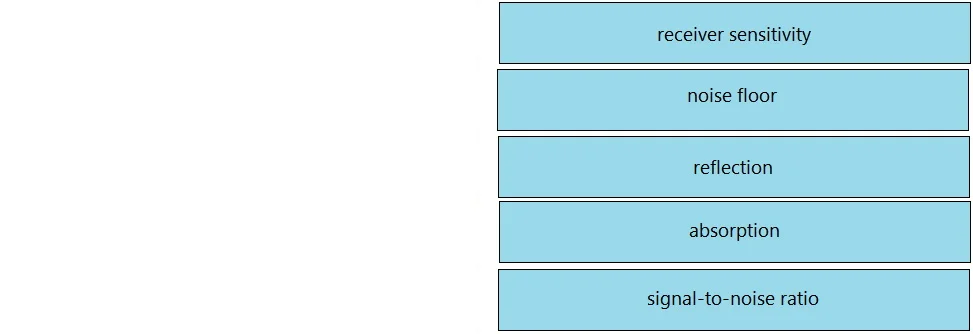
The correct answer is receiver sensitivity; noise floor; reflection; absorption; signal-to-noise ratio. The correct arrangement matches each RF term to its defining characteristic: receiver sensitivity describes the minimum signal level a device can detect, noise floor is the baseline level of background noise in a system, reflection occurs when RF signals bounce off surfaces…
Question
Exhibit
Answer Area
Drag items
Correct arrangement
- receiver sensitivity
- noise floor
- reflection
- absorption
- signal-to-noise ratio
Explanation
The correct arrangement matches each RF term to its defining characteristic: receiver sensitivity describes the minimum signal level a device can detect, noise floor is the baseline level of background noise in a system, reflection occurs when RF signals bounce off surfaces, absorption is when materials convert RF energy into heat (attenuating the signal), and signal-to-noise ratio (SNR) is the comparison between the desired signal strength and the background noise level. Each term has a precise technical definition that uniquely maps to its corresponding statement, making this a test of foundational RF terminology knowledge essential for wireless networking.
Topics
Community Discussion
No community discussion yet for this question.