
200-301 · Question #1080
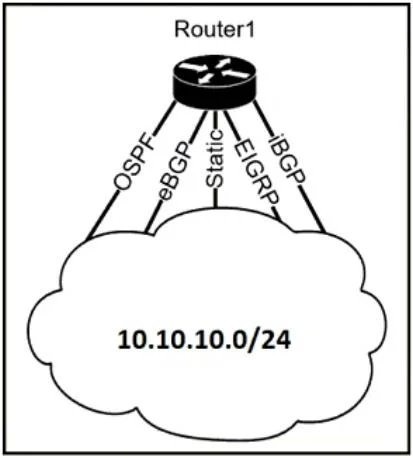
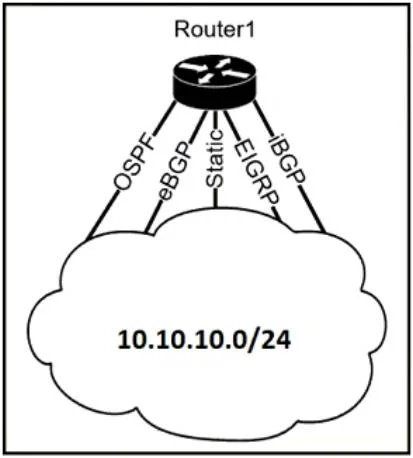
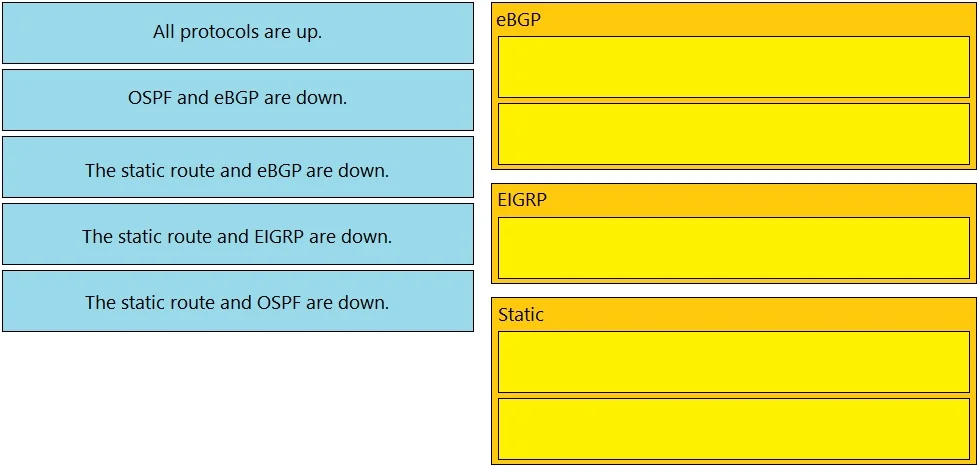
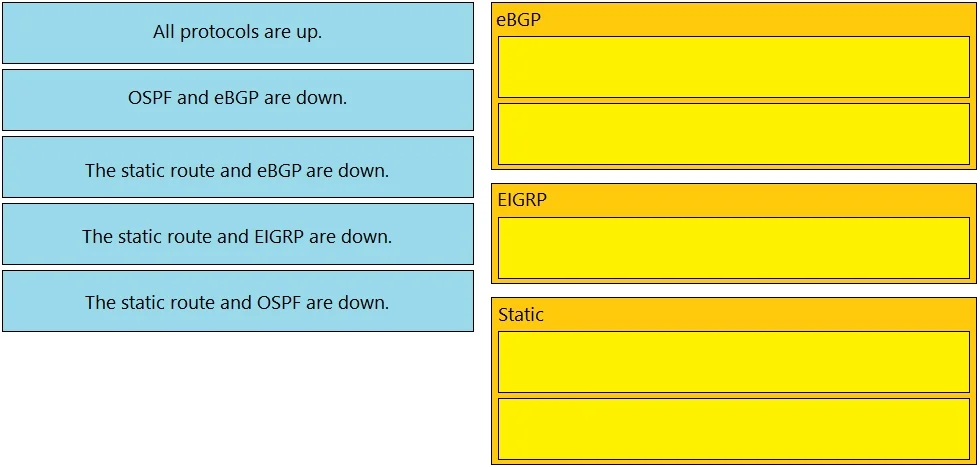
Drag and Drop Question Refer to the exhibit. The Router1 routing table has multiple methods to reach 10.10.10.0/24 as shown. The default Administrative Distance is used. Drag and drop the network…
The correct answer is The static route and EIGRP are down.; The static route and OSPF are down.; The static route and eBGP are down.; All protocols are up.; OSPF and eBGP are down. Administrative Distance & Route Selection - Explained This question tests your understanding of Administrative Distance (AD) - the trustworthiness metric routers use to choose between competing routes to the same destination. Lower AD wins. Key AD Values (memorize these) |…
Question
Exhibits
Answer Area
Drag items
Correct arrangement
- The static route and EIGRP are down.
- The static route and OSPF are down.
- The static route and eBGP are down.
- All protocols are up.
- OSPF and eBGP are down.
Explanation
Administrative Distance & Route Selection - Explained
This question tests your understanding of Administrative Distance (AD) - the trustworthiness metric routers use to choose between competing routes to the same destination. Lower AD wins.
Key AD Values (memorize these)
| Routing Method | Default AD |
|---|---|
| Static route | 1 |
| eBGP | 20 |
| EIGRP (internal) | 90 |
| OSPF | 110 |
Router1 has four ways to reach 10.10.10.0/24: Static, eBGP, EIGRP, OSPF. When multiple routes exist, the lowest AD among currently available routes wins.
Item-by-Item Breakdown
Position 4 - "All protocols are up" All four routes available. Static (AD 1) wins - it's the most trusted. Router uses the static route.
Position 5 - "OSPF and eBGP are down" Remaining: Static (1) and EIGRP (90). Static still wins. Router still uses the static route.
Same result as position 4, but now only two options remain.
Position 1 - "Static route and EIGRP are down" Remaining: eBGP (20) and OSPF (110). eBGP has lower AD. Router uses eBGP.
Position 2 - "Static route and OSPF are down" Remaining: eBGP (20) and EIGRP (90). eBGP still wins. Router uses eBGP.
Both positions 1 and 2 result in eBGP - because eBGP (20) always beats OSPF (110) or EIGRP (90).
Position 3 - "Static route and eBGP are down" Remaining: EIGRP (90) and OSPF (110). EIGRP wins. Router uses EIGRP.
Summary Logic
| Condition | Available Routes | Winner (Lowest AD) |
|---|---|---|
| All up | Static(1), eBGP(20), EIGRP(90), OSPF(110) | Static |
| OSPF + eBGP down | Static(1), EIGRP(90) | Static |
| Static + EIGRP down | eBGP(20), OSPF(110) | eBGP |
| Static + OSPF down | eBGP(20), EIGRP(90) | eBGP |
| Static + eBGP down | EIGRP(90), OSPF(110) | EIGRP |
Common Mistakes
-
Confusing AD with metric. AD compares between routing protocols. Metric (cost, hop count, bandwidth) compares routes within the same protocol. They are completely separate concepts.
-
Thinking OSPF beats EIGRP. OSPF (110) has a higher AD than EIGRP (90), so EIGRP is preferred - even though OSPF is often considered more "enterprise." Higher AD = less trusted.
-
Forgetting eBGP vs iBGP. eBGP (external BGP) has AD 20. iBGP (internal BGP) has AD 200. This question uses eBGP - a very common exam gotcha. iBGP would lose to almost everything.
-
Assuming the static route always wins. It does - unless it's explicitly stated as "down." When the static route is gone, you fall back to the next lowest AD, which is eBGP (20).
Topics
Community Discussion
No community discussion yet for this question.