
200-301 · Question #1073
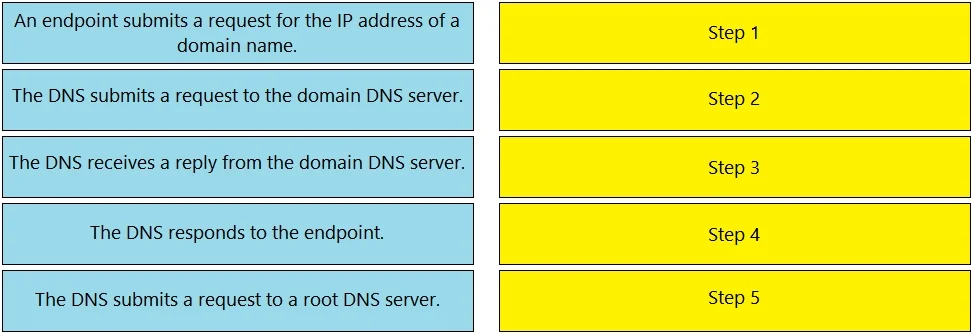
Drag and Drop Question Drag and drop the steps in a standard DNS lookup operation from the left into the order on the right. Answer:
A standard DNS lookup follows a hierarchical resolution process: the endpoint first requests an IP address, the local DNS resolver checks its cache and then queries a root DNS server to find the authoritative name server for the top-level domain, next queries the domain's…
Question
Exhibits
Options
- Box1An endpoint submits a request for the IP address of a domain name.
- Box2The DNS submits a request to the domain DNS server.
- Box3The DNS receives a reply from the domain DNS server.
- Box4The DNS responds to the endpoint.
- Box5The DNS submits a request to a root DNS server.
Explanation
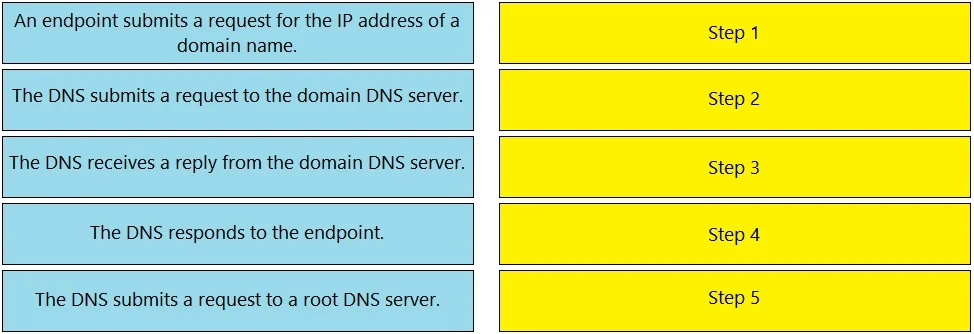
A standard DNS lookup follows a hierarchical resolution process: the endpoint first requests an IP address, the local DNS resolver checks its cache and then queries a root DNS server to find the authoritative name server for the top-level domain, next queries the domain's authoritative DNS server directly, receives the IP address reply, and finally returns that IP address to the requesting endpoint. The correct order is: Box1 (endpoint submits request) → Box5 (DNS queries root server) → Box2 (DNS queries domain DNS server) → Box3 (DNS receives reply from domain server) → Box4 (DNS responds to endpoint). This recursive/iterative resolution ensures the DNS hierarchy is followed from the top (root) down to the authoritative source before delivering the answer.
Topics
Community Discussion
No community discussion yet for this question.