
200-201 · Question #305
Refer to the exhibit. An engineer received a ticket about a slowdown of a web application. During analysis of traffic, the engineer suspects a possible attack on a web server. How should the…
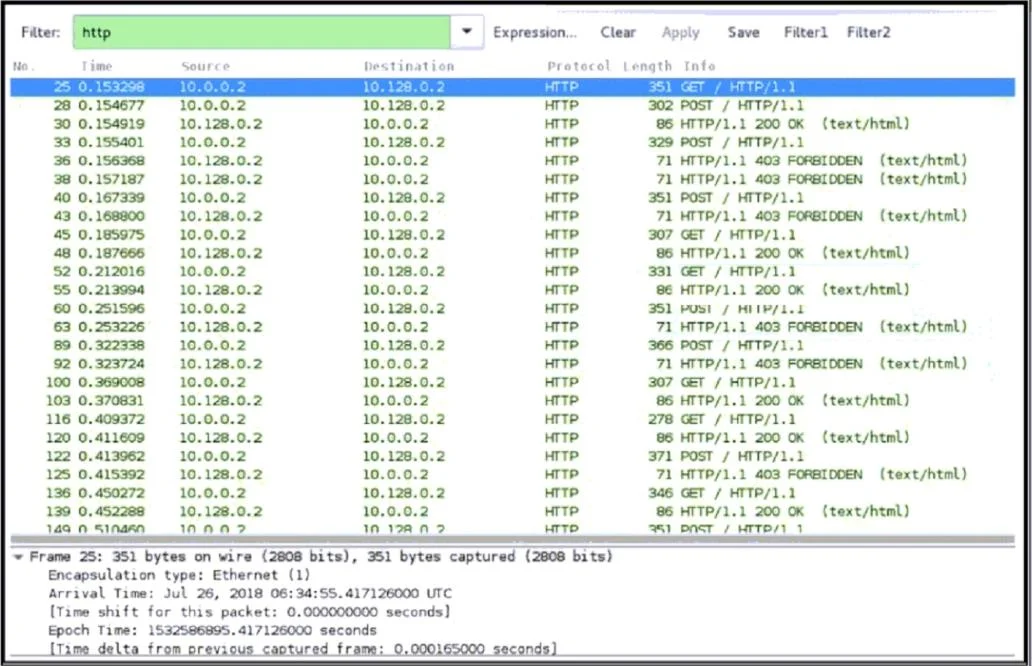
The correct answer is B. 10.0.0.2 sends GET / HTTP / 1.1 and POST requests, and the target responds with HTTP/1.1. The Wireshark capture shows that IP address 10.0.0.2 is sending both GET and POST HTTP requests to a target, which then responds with HTTP/1.1 200 OK messages.
Question
Refer to the exhibit. An engineer received a ticket about a slowdown of a web application. During analysis of traffic, the engineer suspects a possible attack on a web server. How should the engineer interpret the Wireshark traffic capture?
Exhibit
Options
- A10.128.0.2 sends HTTP / FORBIDDEN / 1.1 and GET requests, and the target responds with
- B10.0.0.2 sends GET / HTTP / 1.1 and POST requests, and the target responds with HTTP/1.1
- C10.128.0.2 sends POST / HTTP / 1.1 and GET requests, and the target responds with HTTP/1.1
- D10.0.0.2 sends HTTP / FORBIDDEN / 1.1 and POST requests, while the target responds with
How the community answered
(53 responses)- A9% (5)
- B68% (36)
- C4% (2)
- D19% (10)
Why each option
The Wireshark capture shows that IP address 10.0.0.2 is sending both GET and POST HTTP requests to a target, which then responds with HTTP/1.1 200 OK messages.
This option incorrectly states that 10.128.0.2 is sending the requests and that responses are 'FORBIDDEN', neither of which is shown in the capture.
The traffic capture clearly indicates packets originating from 10.0.0.2 sending `GET / HTTP/1.1` and `POST / HTTP/1.1` requests, and the target IP, 10.128.0.2, responding with `HTTP/1.1 200 OK` messages, signifying successful responses.
This option incorrectly identifies 10.128.0.2 as the source of the GET and POST requests, which are actually sent by 10.0.0.2.
This option incorrectly states that 'HTTP / FORBIDDEN / 1.1' is sent as a request type and that the target's response is not fully described as 200 OK.
Concept tested: Wireshark HTTP traffic analysis
Source: https://www.wireshark.org/docs/dfref/h/http.html
Topics
Community Discussion
No community discussion yet for this question.