
200-201 · Question #192
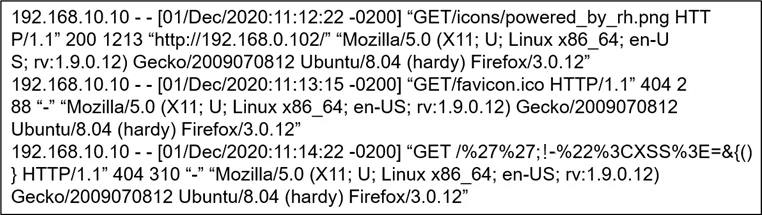
Refer to the exhibit. What is occurring within the exhibit?
The correct answer is D. cross-site scripting attack. Without the exhibit, if option D (cross-site scripting attack) is correct, the exhibit would likely show malicious script injection into web pages, typically through user-supplied input.
Question
Refer to the exhibit. What is occurring within the exhibit?
Exhibit
Options
- Aregular GET requests
- BXML External Entities attack
- Cinsecure deserialization
- Dcross-site scripting attack
How the community answered
(31 responses)- A16% (5)
- B3% (1)
- C6% (2)
- D74% (23)
Why each option
Without the exhibit, if option D (cross-site scripting attack) is correct, the exhibit would likely show malicious script injection into web pages, typically through user-supplied input.
Regular GET requests are standard web traffic and do not indicate an attack unless they contain malicious parameters or payloads associated with other attack types.
An XML External Entity (XXE) attack involves exploiting vulnerabilities in XML parsers to access local or remote files, which would manifest differently than script injection in a web page.
Insecure deserialization attacks involve manipulating serialized objects, which would appear as unusual object data in requests or responses, not typically as direct script injection in visible web content.
A cross-site scripting (XSS) attack involves injecting malicious client-side scripts into web pages viewed by other users. If the exhibit depicts requests or responses containing injected script tags (e.g., <script>alert('XSS')</script>) or other script execution vectors, then XSS is occurring.
Concept tested: Cross-site scripting (XSS) attack
Source: https://portswigger.net/web-security/cross-site-scripting
Topics
Community Discussion
No community discussion yet for this question.