
200-150 · Question #130
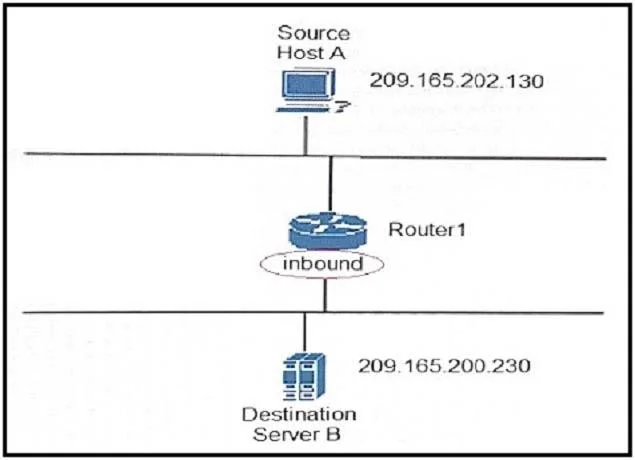
Refer to the exhibit. You are configuring an extended access list to permit a reply from Destination Server B to Source Host A for HTTP traffic. Which extended access list should you implement on…
The correct answer is B. router(config)# permit tcp host 209.165.200.230 eq www host 209.165.202.130. Extended ACLs match on source IP, optional source port, destination IP, and optional destination port - a reply from an HTTP server originates FROM port 80 on the server side.
Question
Refer to the exhibit. You are configuring an extended access list to permit a reply from Destination Server B to Source Host A for HTTP traffic. Which extended access list should you implement on the inbound interface of Router1?
Exhibit
Options
- Arouter(config)# permit tcp host 209.165.200.230 host 209.165.202.130 eq www
- Brouter(config)# permit tcp host 209.165.200.230 eq www host 209.165.202.130
- Crouter(config)# permit tcp host 209.165.202.130 host 209.165.200.230 eq www
- Drouter(config)# permit tcp host 209.165.202.130 eq www host 209.165.200.230
How the community answered
(22 responses)- A5% (1)
- B77% (17)
- C5% (1)
- D14% (3)
Why each option
Extended ACLs match on source IP, optional source port, destination IP, and optional destination port - a reply from an HTTP server originates FROM port 80 on the server side.
Placing 'eq www' after the destination matches destination port 80, which would permit a new outbound request to Server B rather than a reply originating from Server B's port 80.
When Server B (209.165.200.230) replies to an HTTP request, the TCP segment originates from source port 80 (www) on Server B and is destined for Host A (209.165.202.130). The extended ACL syntax is 'permit tcp <source> [eq <port>] <destination>', so 'permit tcp host 209.165.200.230 eq www host 209.165.202.130' correctly matches Server B as the source with source port 80 sending to Host A.
This reverses the source and destination - it permits Host A (209.165.202.130) to send traffic to Server B on destination port 80, which is the original outbound request, not the return reply.
This matches Host A as the source with source port 80 destined for Server B, which is nonsensical for a reply and has both source/destination reversed from the correct direction.
Concept tested: Cisco extended ACL syntax for TCP reply traffic
Source: https://www.cisco.com/c/en/us/support/docs/security/ios-firewall/23602-confaccesslists.html
Topics
Community Discussion
No community discussion yet for this question.