
1Z0-997 · Question #8
Your company will soon start moving critical systems Into Oracle Cloud Infrastructure (OCI) platform. These systems will reside in the us-phoenix-1and us-ashburn 1 regions. As part of the migration…
The correct answer is D. Autoscaling is using an Instance Pool configured to create instances in two availability Domains. Explanation/Reference: Block Volume Encryption By default all volumes and their backups are encrypted using the Oracle-provided encryption keys. Each time a volume is cloned or restored from a backup the volume is assigned a new unique encryption key. You have the option to…
Question
Your company will soon start moving critical systems Into Oracle Cloud Infrastructure (OCI) platform. These systems will reside in the us-phoenix-1and us-ashburn 1 regions. As part of the migration planning, you are reviewing the company's existing security policies and written guidelines for the OCI platform usage within the company. Which two options ensure compliance with this policy?
Exhibit
Options
- AAutoscaling only works with single availability domains.
- BYou have to manually acid all three availability domains to your load balancer configuration.
- CAutoscaling can be enabled for multiple availability domains only in uklondon t region.
- DAutoscaling is using an Instance Pool configured to create instances in two availability Domains.
- EYou forgot to attach a load balancer to your instance pool configuration.
How the community answered
(63 responses)- A2% (1)
- B2% (1)
- C14% (9)
- D76% (48)
- E6% (4)
Explanation
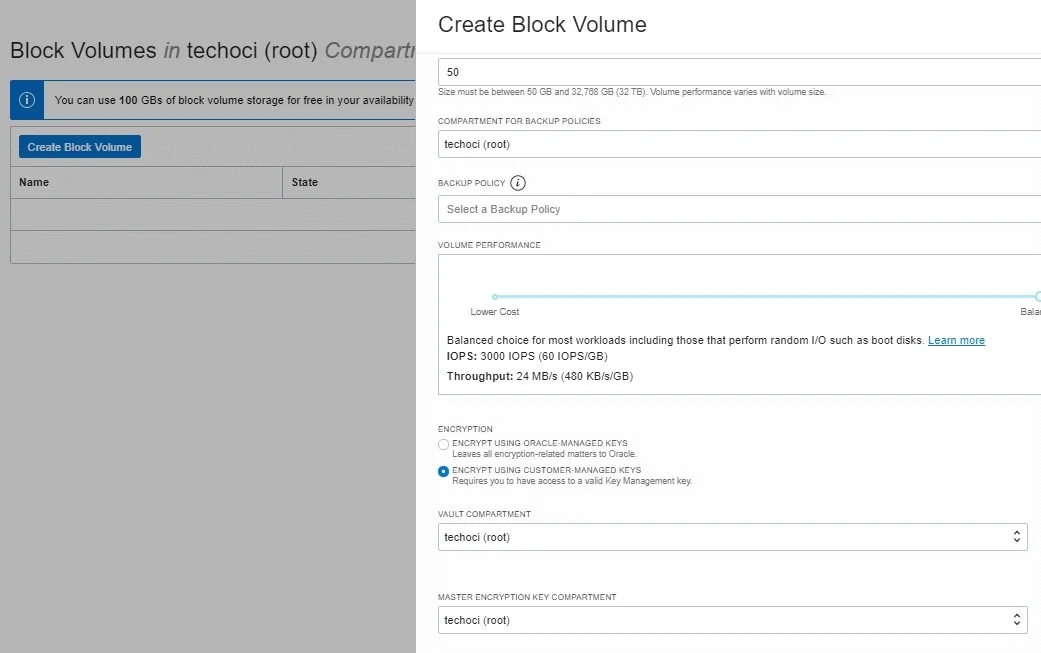
Explanation/Reference: Block Volume Encryption By default all volumes and their backups are encrypted using the Oracle-provided encryption keys. Each time a volume is cloned or restored from a backup the volume is assigned a new unique encryption key. You have the option to encrypt all of your volumes and their backups using the keys that you own and manage using the Vault service.If you do not configure a volume to use the Vault service or you later unassign a key from the volume, the Block Volume service uses the Oracle-provided encryption key instead. This applies to both encryption at-rest and in-transit encryption. Object Storage Encryption Object Storage employs 256-bit Advanced Encryption Standard (AES-256) to encrypt object data on the server. Each object is encrypted with its own data encryption key. Data encryption keys are always encrypted with a master encryption key that is assigned to the bucket. Encryption is enabled by default and cannot be turned off. By default, Oracle manages the master encryption key. However, you can optionally configure a bucket so that it's assigned an Oracle Cloud Infrastructure Vault master encryption key that you control and rotate on your own schedule. Encryption: Buckets are encrypted with keys managed by Oracle by default, but you can optionally encrypt the data in this bucket using your own Vault encryption key. To use Vault for your encryption needs, select Encrypt Using Customer-Managed Keys. Then, select the Vault Compartment and Vault that contain the master encryption key you want to use. Also select the Master Encryption Key Compartment and Master Encryption Key. domains is not receiving any traffic. What could be wrong In this situation? Explanation/Reference: Autoscaling lets you automatically adjust the number of Compute instances in an instance pool based on performance metrics such as CPU utilization. This helps you provide consistent performance for your end users during periods of high demand, and helps you reduce your costs during periods of low demand. you can associate a load balancer with an instance pool. If you do this, when you add an instance to the instance pool, the instance is automatically added to the load balancer's backend set . After the instance reaches a healthy state (the instance is listening on the configured port number), incoming traffic is automatically routed to the new instance. Instance pools let you provision and create multiple Compute instances based off the same configuration, within the same region. By default, the instances in a pool are distributed across all fault Domains in a best-effort manner based on capacity. If capacity isn't available in one fault domain, the instances are placed in other fault domains to allow the instance pool to launch successfully. In a high availability scenario, you can require that the instances in a pool are evenly distributed across each of the fault domains that you specify. When sufficient capacity isn't available in one of the fault domains, the instance pool will not launch or scale successfully, and a work request for the instance pool will return an "out of capacity" error. To fix the capacity error, either wait for capacity to become available, or use the UpdateInstancePool operation to update the placement configuration (the availability domain and fault domain) for the instance pool. during create the instance pool you can select the location where you want to place the instances" In the Availability Domain list, select the availability domain to launch the instances in. If you want the instances in the pool to be placed evenly in one or more fault domains, select the Distribute instances evenly across selected fault domains check box. Then, select the fault domains to place the instances in.
Topics
Community Discussion
No community discussion yet for this question.