
1Z0-997 · Question #74
All three Data Guard Configuration are fully supported on Oracle Cloud infrastructure (OCI). You want to deploy a maximum availability architecture (MAA) for database workload. Which option should…
The correct answer is B. Launch a compute Instance and run an run an NGINX server to host the application. Explanation/Reference: https://docs.cloud.oracle.com/en-us/iaas/Content/Resources/Assets/whitepapers/best-practices-for-dr- on-oci.pdf All three Data Guard configurations are fully supported on Oracle Cloud Infrastructure. However, because of a high risk of production outage…
Question
All three Data Guard Configuration are fully supported on Oracle Cloud infrastructure (OCI). You want to deploy a maximum availability architecture (MAA) for database workload. Which option should you consider while designing your Data Guard configuration to ensure best RTO and PRO without causing any data loss?
Exhibit
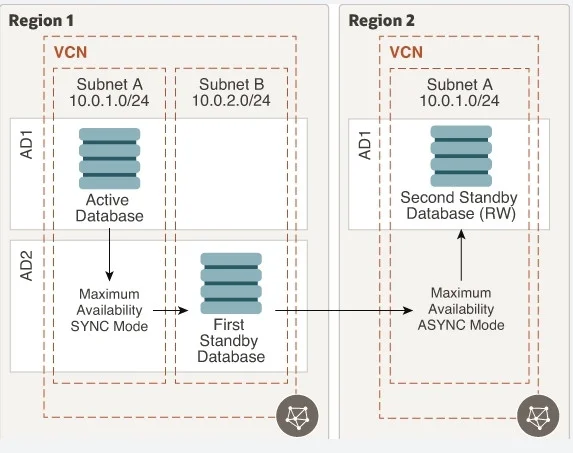
Options
- ALaunch a Compute instance and run an NGINX Serve to host the application.
- BLaunch a compute Instance and run an run an NGINX server to host the application.
- CLaunch a compute Instance and run an NGINX server to host the application.
- DLaunch a compute Instance for both the NGINX application server and the database server.
How the community answered
(22 responses)- B82% (18)
- C5% (1)
- D14% (3)
Explanation
Explanation/Reference: https://docs.cloud.oracle.com/en-us/iaas/Content/Resources/Assets/whitepapers/best-practices-for-dr- on-oci.pdf All three Data Guard configurations are fully supported on Oracle Cloud Infrastructure. However, because of a high risk of production outage, we don't recommend using the maximum protection mode for your Data Guard configuration. We recommend using the maximum availability mode in SYNC mode between two availability domains (same region), and using the maximum availability mode in ASYNC mode between two regions. This architecture provides you the best RTO and RPO without causing any data loss. We recommend building this architecture in daisy-chain mode: the primary database ships redo logs to the first standby database in another availability domain in SYNC mode, and then the first standby database ships the redo logs to another region in ASYNC mode. This method ensures that your primary database is not doing the double work of shipping redo logs, which can cause performance impact on a production workload. This configuration offers the following benefits: No data loss within a region. A cost conscious fashions design company which sells bags, clothes, and other luxury items has recently decided to more all of the their on-premises infrastructure Oracle Cloud Infrastructure (OCI), One of their on-premises application is running on an NGINX server and the Oracle Database is running in a 2 node Oracle Real Application Clusters (RAC) configuration. Based on cost considerations, what is an effective mechanism to migrate the customer application to OCI and set up regular automated backups? Deploy a 2 node VM DB Systems with Oracle RAC enabled Import the on premises database to OCI VM DB Systems using data pump and then enable automatic backup-Also, enable Oracle Data Guard on the database server Deploy a 2 node VM DB Systems with oracle RAC enabled import the on premises database to OCI VM DB Systems using oracle Data Pump and then enable automatic backups. Deploy Exadata Quarter Rack, enable automatic backups and import the database using Oracle Data Pump. Attach block volumes on the database server compute instance and enable backup policy to backup the block volumes. Explanation/Reference: Based on cost considerations will exclude the Exadata. and there's no need for Data Guard Cost Estimator
Topics
Community Discussion
No community discussion yet for this question.