
1Z0-909 · Question #57
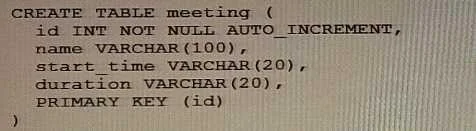
The meeting table stores meeting schedules with participants from five continents. The participants' details are stored in another table. You need to adjust the start_time and duration columns for…
The correct answer is C. start_time DATETIME duration DATETIME. DATETIME is correct for start_time because meetings require both a date and a time component, and with participants spanning five continents, the wider range and date precision of DATETIME is essential - unlike TIMESTAMP, which is limited to dates up to 2038 and applies…
Question
The meeting table stores meeting schedules with participants from five continents. The participants' details are stored in another table. You need to adjust the start_time and duration columns for optimal storage. What datatype changes would achieve this?
Exhibit
Options
- Astart_time TIMESTAMP duration TIMESTAMP
- Bstart_time TIMESTAMP duration TIME
- Cstart_time DATETIME duration DATETIME
- Dstart_time TIME duration TIME
- Estart__time DATETIME duration TIME
How the community answered
(41 responses)- A10% (4)
- B2% (1)
- C83% (34)
- E5% (2)
Explanation
DATETIME is correct for start_time because meetings require both a date and a time component, and with participants spanning five continents, the wider range and date precision of DATETIME is essential - unlike TIMESTAMP, which is limited to dates up to 2038 and applies automatic timezone conversion that can corrupt stored values in global contexts.
DATETIME is correct for duration in this context because meeting durations that may span across days (multi-timezone scheduling, overnight sessions) need a full date-time representation, not just a time component.
Why the distractors fail:
- A -
TIMESTAMPfor both is wrong becauseTIMESTAMPhas a narrow range (1970–2038) and its timezone-conversion behavior makes it unreliable for global scheduling. - B -
TIMESTAMPforstart_timecarries the same 2038 and timezone pitfalls;TIMEfor duration is too narrow for multi-day representations. - D -
TIMEforstart_timeis wrong outright - it stores only a time-of-day, with no date, making it useless for scheduling. - E - Contains a typo (
start__timewith a double underscore), which would cause a SQL error; always valid on exams as a trap for careless readers.
Memory tip: Think "five continents = full datetime needed" - when scope is global and spans days, reach for DATETIME. If you see TIMESTAMP in a question about the far future or global systems, it's almost always a distractor.
Topics
Community Discussion
No community discussion yet for this question.