
1Z0-909 · Question #50
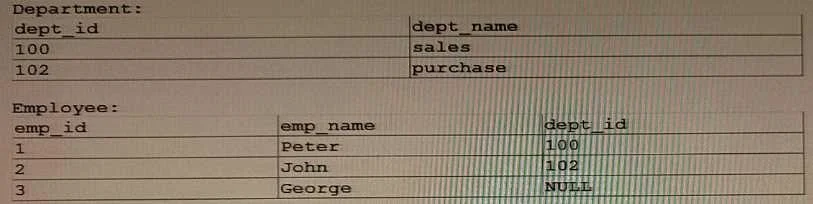
Examine the contents of these tables: Now examine the expected results for a user with privileges to access the table: Which query returns the expected results? A. B. C. D.
The correct answer is B. SELECT emp_id, (SELECT dept_name FROM department WHERE dept_id = employee.dept_id) FROM employee. Option B uses a correlated subquery that executes for each row in employee, looking up the matching dept_name from department where dept_id matches - this correctly returns all employees, including those with no department (returning NULL for dept_name), which matches the…
Question
Examine the contents of these tables:
Now examine the expected results for a user with privileges to access the table:
Which query returns the expected results? A. B. C. D.
Exhibit
Options
- ASELECT e.emp_id, d.dept_name FROM employee e, department d WHERE d.dept_id = e.dept_id;
- BSELECT emp_id, (SELECT dept_name FROM department WHERE dept_id = employee.dept_id) FROM employee;
- CSELECT e.emp_id, d.dept_name FROM employee e LEFT JOIN department d ON d.dept_id = e.dept_id WHERE e.dept_id IS NULL;
- DSELECT emp_id, (SELECT dept_name FROM department) dept_name FROM employee WHERE dept_id = employee.dept_id;
How the community answered
(29 responses)- A7% (2)
- B72% (21)
- C3% (1)
- D17% (5)
Explanation
Option B uses a correlated subquery that executes for each row in employee, looking up the matching dept_name from department where dept_id matches - this correctly returns all employees, including those with no department (returning NULL for dept_name), which matches the expected output.
Why the distractors fail:
- A uses an implicit inner join (
FROM employee e, department d WHERE ...), which silently excludes any employee whosedept_idis NULL or has no matching department row - missing rows the expected results include. - C applies a
LEFT JOINbut then addsWHERE e.dept_id IS NULL, turning it into a filter that returns only unmatched employees, the opposite of a complete result set. - D's subquery
(SELECT dept_name FROM department)has no correlated condition linking it to the outer query'sdept_id, so it returns multiple rows and causes a runtime error; the outerWHERE dept_id = employee.dept_idalso compares a column to itself (always true), which is logically broken.
Memory tip: When you see a subquery in the SELECT clause referencing an outer table's column in its WHERE clause (e.g., WHERE dept_id = employee.dept_id), that's a correlated subquery - it's the SQL equivalent of a LEFT JOIN that returns NULL for non-matches, making it your go-to when the expected results include rows with no corresponding child record.
Topics
Community Discussion
No community discussion yet for this question.