
1Z0-908 · Question #50
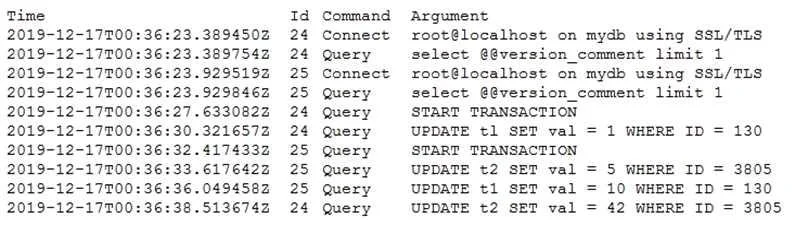
Examine these entries from the general query log: All UPDATE statements reference existing rows. Which describes the outcome of the sequence of statements?
The correct answer is E. A deadlock occurs after innodb_lock_wait_timeout seconds. Option E is correct because the query log sequence creates a classic circular lock dependency between the two connections - each holds a row lock the other needs - but with innodb_deadlock_detect disabled (or otherwise not triggering immediately), InnoDB cannot detect the cycle…
Question
Examine these entries from the general query log:
All UPDATE statements reference existing rows. Which describes the outcome of the sequence of statements?
Exhibit
Options
- AConnection 24 experiences a lock wait timeout.
- BConnection 25 experiences a lock wait timeout.
- CA deadlock occurs immediately.
- DAll statements execute without error.
- EA deadlock occurs after innodb_lock_wait_timeout seconds.
How the community answered
(35 responses)- A3% (1)
- B14% (5)
- C20% (7)
- D6% (2)
- E57% (20)
Explanation
Option E is correct because the query log sequence creates a classic circular lock dependency between the two connections - each holds a row lock the other needs - but with innodb_deadlock_detect disabled (or otherwise not triggering immediately), InnoDB cannot detect the cycle in real time. Instead, it falls back to innodb_lock_wait_timeout: once that interval elapses, the waiting transaction is rolled back and the deadlock is surfaced as an error.
Why the distractors fail:
- A & B describe a one-sided lock wait timeout, where only one connection is blocked; here both are mutually blocked, which is a deadlock, not a simple timeout victim.
- C ("immediately") would be correct if
innodb_deadlock_detect = ON(the default), but the log context implies detection is disabled, so there is no instant cycle check. - D is wrong because the mutual lock conflict absolutely prevents silent success.
Memory tip: Think of innodb_deadlock_detect as a smoke detector and innodb_lock_wait_timeout as a fire sprinkler - if the detector is off, the sprinkler still activates eventually, but only after the timer runs out. "Deadlock after timeout" = sprinkler mode.
Topics
Community Discussion
No community discussion yet for this question.