nerdexam
Oracle

1Z0-900 · Question #33

Given: You are creating an Alarm management system. When you create a new alarm, you want it to create an alert that is triggered once at the specified time. Which method should you call on Line 9 to

The correct answer is D. timerService.createTimer(alarmDate, -l, config);. timerService.createTimer(alarmDate, -1, config) is the correct legacy EJB Timer Service method for creating a one-time timer - passing -1 as the interval duration tells the container not to repeat the timer after its initial firing at alarmDate. Option A (createCalendarTimer) req

Implement Business Logic by Using EJBs

Question

Given:

You are creating an Alarm management system. When you create a new alarm, you want it to create an alert that is triggered once at the specified time. Which method should you call on Line 9 to create the timer?

Exhibit
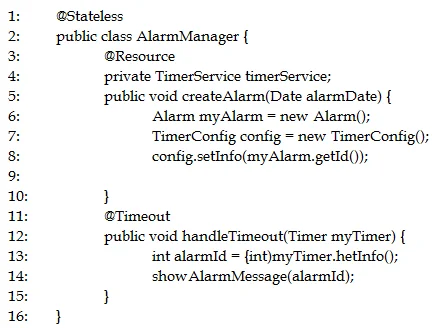
1Z0-900 question #33 exhibit

Options

  • AtimerService.createCalendarTimer(alarmDate, config);
  • BtimerService.createSingleActionTimer(alarmDate, config);
  • CtimerService.createIntervalTimer(alarmDate, -l, config);
  • DtimerService.createTimer(alarmDate, -l, config);

How the community answered

(38 responses)
  • A
    5% (2)
  • B
    13% (5)
  • C
    3% (1)
  • D
    79% (30)

Explanation

timerService.createTimer(alarmDate, -1, config) is the correct legacy EJB Timer Service method for creating a one-time timer - passing -1 as the interval duration tells the container not to repeat the timer after its initial firing at alarmDate.

Option A (createCalendarTimer) requires a ScheduleExpression (cron-style expression), not a plain Date, making it unsuitable for a simple point-in-time alarm.

Option B (createSingleActionTimer) is from the EJB 3.1+ API and would seem intuitive, but the question targets the older createTimer API where this method is not available - the context (method signatures, parameter types) signals the pre-3.1 programming model.

Option C (createIntervalTimer) is semantically wrong regardless of the -1 argument - it is designed for repeating timers and expects a valid positive interval duration.

Memory tip: Think of the -1 as a "null interval" - it's a sentinel value telling the EJB container "fire once, then stop." If you see createTimer(Date, long, Serializable) with a negative second argument, that negative value is the clue that it's a single-action timer in the legacy API.

Topics

#EJB Timer Service#Single-action timer#Timer creation#Scheduled execution

Community Discussion

No community discussion yet for this question.

Full 1Z0-900 Practice