
1Z0-822 · Question #135
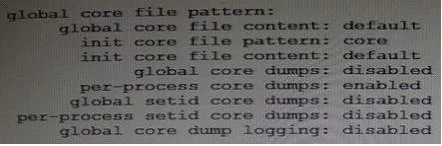
The following information describes the current dump configuration of your server: Assume that the following command lines have been run on a system: (root) # coreadm -g $HOME/var/core/%m.core.%f.%t…
The correct answer is B. A copy of a core file will appear in the process' current working directory. Set the per-process core file name pattern to pattern for each of the specified process-IDs. The pattern can contain any of the special % variables %f, executable file name, up to a maximum of MAXCOMLEN characters %p, process-ID Example. The core file name pattern…
Question
The following information describes the current dump configuration of your server:
Assume that the following command lines have been run on a system:
(root) # coreadm -g $HOME/var/core/%m.core.%f.%t (non-root) $ coreadm -p core.%f.%p Identify the result of a subsequent process crash.
Exhibit
Options
- AA copy of a core file will appear in /var/core.
- BA copy of a core file will appear in the process' current working directory.
- CThe root copy will include the taskid of the process.
- DThe nonroot copy will include the day of the process crash.
- EThe global format will override the per-process format.
- FThe global core dump is disabled, so a core file will not be saved.
How the community answered
(40 responses)- A10% (4)
- B48% (19)
- C30% (12)
- D3% (1)
- E3% (1)
- F8% (3)
Explanation
Set the per-process core file name pattern to pattern for each of the specified process-IDs. The pattern can contain any of the special % variables %f, executable file name, up to a maximum of MAXCOMLEN characters %p, process-ID * Example. The core file name pattern: /var/core/core.%f.%p would result, for command foo with process-ID 1234, in the core file name: /var/core/core.foo.1234 * Example. Setting the core file name pattern When executed from a user's $HOME/.profile or $HOME/.login, the following command sets the core file name pattern for all processes run during the login session: example$ coreadm -p core.%f.%p $$ $$ is the process-id of the currently running shell. The per-process core file name pattern is inherited by all child processes. Note (see synopsis 2 below). * The coreadm command is used to specify the name and location of core files produced by abnormally-terminating processes. coreadm [-g pattern] [-i pattern] [-d option...] [-e option...] coreadm [-p pattern] [pid...] The first form shown in the synopsis can be executed only by the super-user and is used to configure system-wide core file options, including a global core file name pattern and a per- process core file name pattern for the init(1M) process. The second form can be executed by non-privileged users and is used to specify the file name pattern to be used by the operating system when generating a per-process core file.
Topics
Community Discussion
No community discussion yet for this question.