
1Z0-821 · Question #139
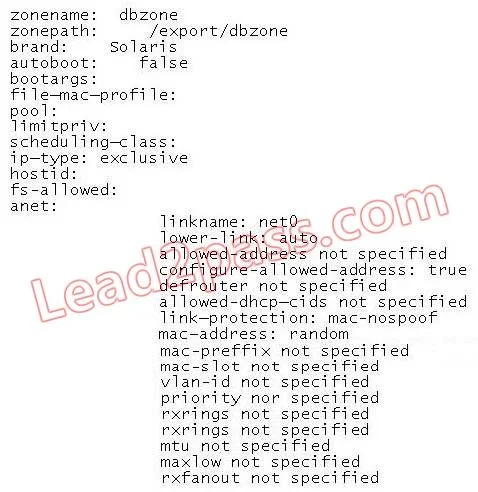
You have completed configuring a zone named dbzone on your Solaris 11 server. The configuration is as following: The global zone displays the following network information: The zone has never been…
The correct answer is B. It is a whole root zone. E. The zone shares the network interface with the host. G. The hostid is the same as the global zone. B: Solaris 11 zones is whole root zone. Note that ip-type: exclusive: Starting with OpenSolaris build 37 and Oracle Solaris 10 8/07, a default zone can be configured as an "exclusive-IP zone" which gives it exclusive access to the NIC(s) that the zone has been assigned…
Question
You have completed configuring a zone named dbzone on your Solaris 11 server. The configuration is as following:
The global zone displays the following network information:
The zone has never been booted. Which three options correctly describe this zone?
Exhibits

Options
- AIt is a sparse root zone.
- BIt is a whole root zone.
- CIt is an immutable zone.
- DIt is a native zone.
- EThe zone shares the network interface with the host.
- FThe zone uses a virtual network interface.
- GThe hostid is the same as the global zone.
- HThe IP address of the zone is 10.0.2.18.
How the community answered
(27 responses)- B74% (20)
- C4% (1)
- D15% (4)
- F7% (2)
Explanation
B: Solaris 11 zones is whole root zone. Note that ip-type: exclusive: Starting with OpenSolaris build 37 and Oracle Solaris 10 8/07, a default zone can be configured as an "exclusive-IP zone" which gives it exclusive access to the NIC(s) that the zone has been assigned. Applications in such a zone can communicate directly with the NIC(s) available to the After installing Oracle Solaris on a system, but before creating any zones, all processes run in the global zone. After you create a zone, it has processes that are associated with that zone and no other zone. Any process created by a process in a non-global zone is also associated with that non-global zone. Any zone which is not the global zone is called a non-global zone. Most people call non-global zones simply "zones." Some people call them "local zones" but this is discouraged. The default native zone file system model on Oracle Solaris 10 is called "sparse-root." This model emphasizes efficiency and security at the cost of some configuration flexibility. Sparse-root zones optimize physical memory and disk space usage by sharing some directories, like /usr and /lib. Sparse-root zones have their own private file areas for directories like /etc and /var. Whole-root zones increase configuration flexibility but increase resource usage. They do not use shared file systems for /usr, /lib, and a few others. There is no supported way to convert an existing sparse-root zone to a whole-root zone. Creating a new zone is required.
Topics
Community Discussion
No community discussion yet for this question.