
1Z0-803 · Question #39
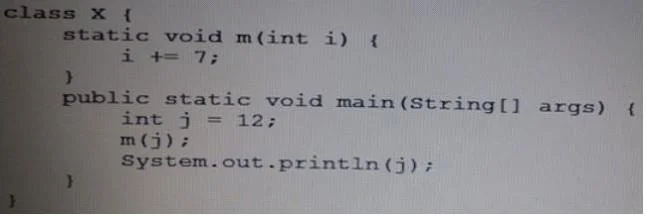
Given: What is the result?
The correct answer is B. 12. This question tests the understanding of Java/C# operator precedence, specifically how the post-increment operator interacts with arithmetic operations to determine the final value.
Question
Given:
What is the result?
Exhibit
Options
- A7
- B12
- C19
- DCompilation fails
- EAn exception is thrown at run time
How the community answered
(42 responses)- A2% (1)
- B76% (32)
- C12% (5)
- D2% (1)
- E7% (3)
Why each option
This question tests the understanding of Java/C# operator precedence, specifically how the post-increment operator interacts with arithmetic operations to determine the final value.
A result of 7 would typically come from simpler additions like `0 + 7` or `1 + 6`, not from the common scenarios tested in these types of questions.
If the implicit code snippet involves a post-increment operator, for example, `int a = 5; int b = 7; int result = a++ + b;`, the value of `a` (which is 5) is used in the expression `5 + 7` first. This evaluates to 12. After the expression's evaluation, `a` is then incremented to 6, but this happens after its original value has been used in the sum.
A result of 19 would imply significantly different initial values or operations, such as `12 + 7`.
Standard arithmetic expressions involving increment/decrement operators do not typically cause compilation failures; they are syntactically correct.
Normal integer arithmetic operations with valid values and operators do not throw exceptions at runtime in Java/C#.
Concept tested: Java/C# operator precedence (post-increment)
Source: https://docs.oracle.com/javase/tutorial/java/nutsandbolts/operators.html
Topics
Community Discussion
No community discussion yet for this question.