Oracle
1Z0-599 · Question #83
Which new key architectural element introduced in WebLogic Server l2c should you take advantage of when designing Disaster Recovery Centers with active passive mode?
The correct answer is E. GoldenGate, because it is the most effective way to replicate a state across locations. Oracle GoldenGate Oracle GoldenGate is Oracle's strategic product for data distribution and data integration. It is a highperformance software application that uses logbased bidirectional data replication for realtime capture, transformation, routing, and delivery of database…
Clustering
Question
Which new key architectural element introduced in WebLogic Server l2c should you take advantage of when designing Disaster Recovery Centers with active passive mode?
Exhibit
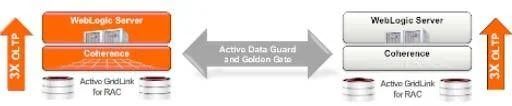
Options
- AMAN Clusters, because they would allow you to synchronously replicate state in low latency
- BWAN Clusters, because they would allow you to asynchronously replicate state in nonlow latency
- CTransaction Log in the database, because you could avoid synchronizing two replication
- DData Guard, because it is the most effective way to replicate a state across locations
- EGoldenGate, because it is the most effective way to replicate a state across locations
How the community answered
(22 responses)- A5% (1)
- B14% (3)
- C9% (2)
- D27% (6)
- E45% (10)
Explanation
- Oracle GoldenGate Oracle GoldenGate is Oracle's strategic product for data distribution and data integration. It is a highperformance software application that uses logbased bidirectional data replication for realtime capture, transformation, routing, and delivery of database transactions across heterogeneous systems. * Oracle Active Data Guard Oracle Active Data Guard 11g is an option of Oracle Database Enterprise Edition that extends basic Data Guard functionality. It allows a physical standby database to be open as readonly while changes are applied to it from the primary database. This increases performance and return on investment by offloading adhoc queries, Webbased access, reporting, and backups from the primary database while also providing disaster protection. * Disaster recovery (DR) procedures ensure rapid recovery or continuation of a technology infrastructure after a natural or humaninduced disaster. Oracle WebLogic Server 12c supports advanced disaster recovery and business continuity. Organizations can store transaction logs in an Oracle database instead of a file system, providing a highly available storage mechanism to improve the speed and reliability of disaster recovery operations. This permits them to utilize Oracle Active Data Guard or Oracle GoldenGate replication technology to move DR state information across data centers. Oracle's enhanced DR architecture enables more effective recovery scenarios. Support for Oracle Exalogic and Oracle Exadata engineered systems ensures tremendous scalability for IT operations of any size. * Oracle WebLogic Server 12c places transaction logs on the database tier to improve the speed, reliability and availability of disaster recovery operations.
Topics
#disaster recovery#active-passive#GoldenGate#WAN clusters
Community Discussion
No community discussion yet for this question.
