
1Z0-456 · Question #7
Based on the looped data defined in the exhibit, identify one correct option that lists all the possible lookup codes that would be displayed when the application passes "US" as a reference…
The correct answer is B. US_CODE1. Lookup codes are identified in an application by the following keys: A lookup view, which defines a distinct set of lookup types. Each lookup view is accessed through its own view, and may have different attributes or different validation, almost as if it were a separate table…
Question
Based on the looped data defined in the exhibit, identify one correct option that lists all the possible lookup codes that would be displayed when the application passes "US" as a reference determination code.
Exhibits

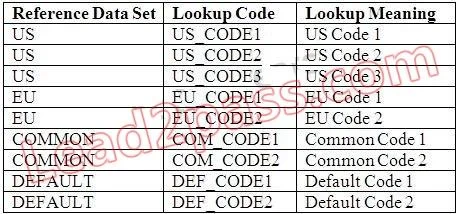
Options
- AUS_CODE1
- BUS_CODE1
- CUS_CODE1
- DUS_CODE1
- ECOM_CODE1
How the community answered
(48 responses)- A13% (6)
- B73% (35)
- C8% (4)
- D4% (2)
- E2% (1)
Explanation
Lookup codes are identified in an application by the following keys: * A lookup view, which defines a distinct set of lookup types. Each lookup view is accessed through its own view, and may have different attributes or different validation, almost as if it were a separate table. * A lookup type, which is a string identifier of a type that groups certain codes together; for example, COLORS. Within each lookup type, multiple lookup codes can be defined. Note: Lookups in applications are used to represent a set of codes and their translated meanings. For example, a product team might store the values 'Y' and 'N' in a column in a table, but when displaying those values they would want to display "Yes" or "No" (or their translated equivalents) instead. Each set of related codes is identified as a lookup type.
Topics
Community Discussion
No community discussion yet for this question.