
1Z0-117 · Question #15
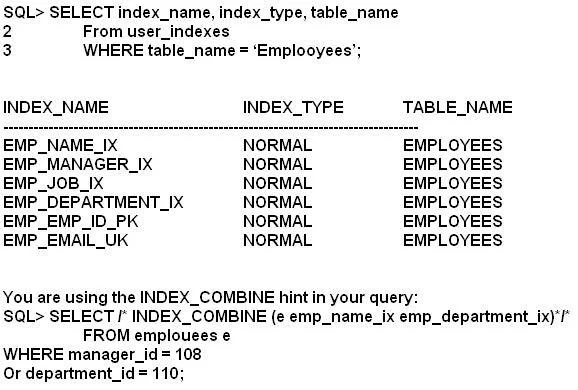
View the code sequence: Which three statements are true about the execution of this query?
The correct answer is A. The optimizer uses an index join as an access path. C. The optimizer uses a bitmap access path for the EMPLOYEES table. F. The optimizer performs bitmap conversion from the row IDs of the combined maps. C: The INDEX_COMBINE hint explicitly chooses a bitmap access path for the table. F: If you specify indexspec, then the optimizer tries to use some Boolean combination of the specified indexes. Each parameter serves the same purpose as in "INDEX Hint". For example: SELECT /+…
Question
View the code sequence:
Which three statements are true about the execution of this query?
Exhibit
Options
- AThe optimizer uses an index join as an access path.
- BThe optimizer uses a B* tree access path for the EMPLOYEES table.
- CThe optimizer uses a bitmap access path for the EMPLOYEES table.
- DThe optimizer performs bitmap conversion from row IDs.
- EThe optimizer performs bitmap conversion to row IDs of the combined maps.
- FThe optimizer performs bitmap conversion from the row IDs of the combined maps.
How the community answered
(16 responses)- A81% (13)
- B13% (2)
- E6% (1)
Explanation
C: The INDEX_COMBINE hint explicitly chooses a bitmap access path for the table. F: If you specify indexspec, then the optimizer tries to use some Boolean combination of the specified indexes. Each parameter serves the same purpose as in "INDEX Hint". For example: SELECT /*+ INDEX_COMBINE(e emp_manager_ix emp_department_ix) */ * FROM employees e WHERE manager_id = 108 OR department_id = 110;
Topics
Community Discussion
No community discussion yet for this question.