
1Z0-117 · Question #125
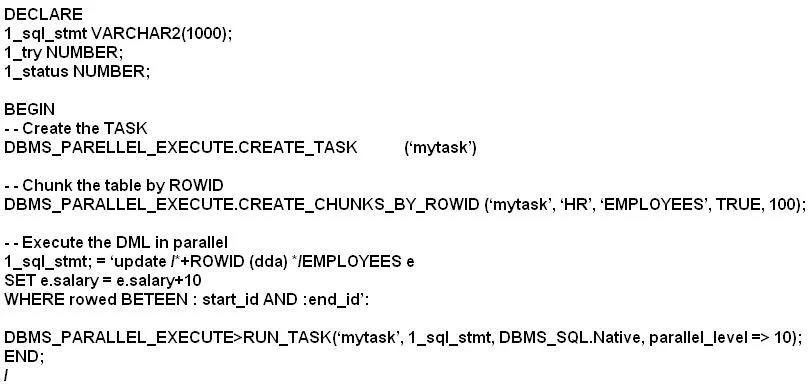
Examine the following anonymous PL/SQL code block of code: Which two are true concerning the use of this code?
The correct answer is A. The user executing the anonymous PL/SQL code must have the CREATE JOB system privilege. E. The user executing the anonymous PL/SQL code requires privilege on the DBMS_SCHEDULER package. A (not D, not E): To use DBMS_PARALLEL_EXECUTE to run tasks in parallel, your schema will need the CREATE JOB system privilege. E (not C): DBMS_PARALLEL_EXECUTE now provides the ability to break up a large table according to a variety of criteria, from ROWID ranges to key…
Question
Examine the following anonymous PL/SQL code block of code:
Which two are true concerning the use of this code?
Exhibit
Options
- AThe user executing the anonymous PL/SQL code must have the CREATE JOB system privilege.
- BALTER SESSION ENABLE PARALLEL DML must be executed in the session prior to executing the
- CAll chunks are committed together once all tasks updating all chunks are finished.
- DThe user executing the anonymous PL/SQL code requires execute privilege on the DBMS_JOB package.
- EThe user executing the anonymous PL/SQL code requires privilege on the DBMS_SCHEDULER package.
- FEach chunk will be committed independently as soon as the task updating that chunk is finished.
How the community answered
(59 responses)- A73% (43)
- B15% (9)
- C7% (4)
- D3% (2)
- F2% (1)
Explanation
A (not D, not E): To use DBMS_PARALLEL_EXECUTE to run tasks in parallel, your schema will need the CREATE JOB system privilege. E (not C): DBMS_PARALLEL_EXECUTE now provides the ability to break up a large table according to a variety of criteria, from ROWID ranges to key values and user-defined methods. You can then run a SQL statement or a PL/SQL block against these different "chunks" of the table in parallel, using the database scheduler to manage the processes running in the background. Error logging, automatic retries, and commits are integrated into the processing of * The DBMS_PARALLEL_EXECUTE package allows a workload associated with a base table to be broken down into smaller chunks which can be run in parallel. This process involves several distinct stages. 2.Split the workload into chunks CREATE_CHUNKS_BY_ROWID CREATE_CHUNKS_BY_NUMBER_COL CREATE_CHUNKS_BY_SQL User-defined framework 4.Check the task status * The workload is associated with a base table, which can be split into subsets or chunks of rows. There are three methods of splitting the workload into chunks. CREATE_CHUNKS_BY_ROWID CREATE_CHUNKS_BY_NUMBER_COL CREATE_CHUNKS_BY_SQL The chunks associated with a task can be dropped using the DROP_CHUNKS procedure. * CREATE_CHUNKS_BY_ROWID The CREATE_CHUNKS_BY_ROWID procedure splits the data by rowid into chunks specified by the CHUNK_SIZE parameter. If the BY_ROW parameter is set to TRUE, the CHUNK_SIZE refers to the number of rows, otherwise it refers to the number of blocks. Reference: TECHNOLOGY: PL/SQL Practices, On Working in Parallel
Topics
Community Discussion
No community discussion yet for this question.