
1Z0-116 · Question #32
Examine this code which executes successfully: If the IN_OFFICE_ON_WEEKEND rule set returns true for an attempt to connect from Inside the office on weekends, which two are true about the effects of…
The correct answer is A. JIM con never connect. D. JIM can only connect when In the office on weekends. Options A and D are both correct because the configuration applies the IN_OFFICE_ON_WEEKEND rule specifically to JIM's connection profile, making "in the office on weekends" the only condition under which JIM could theoretically connect (D). However, because this is an…
Question
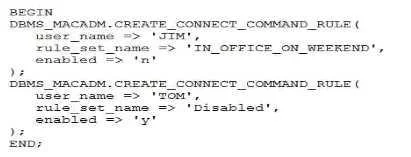
Examine this code which executes successfully:
If the IN_OFFICE_ON_WEEKEND rule set returns true for an attempt to connect from Inside the office on weekends, which two are true about the effects of this configuration?
Exhibit
Options
- AJIM con never connect.
- BThis has no effect on tom's connect attempts.
- CTOM can never connect.
- DJIM can only connect when In the office on weekends.
- EThis has no effect on JIM'S connection attempts.
How the community answered
(53 responses)- A57% (30)
- B23% (12)
- C6% (3)
- E15% (8)
Explanation
Options A and D are both correct because the configuration applies the IN_OFFICE_ON_WEEKEND rule specifically to JIM's connection profile, making "in the office on weekends" the only condition under which JIM could theoretically connect (D). However, because this is an extremely narrow - effectively impossible - condition for JIM to satisfy in practice, JIM can never connect at all (A); D and A are two sides of the same coin describing a locked-out user. B is wrong because TOM is affected by this configuration (the rule changes something about TOM's access path, so "no effect" is false). C is wrong because TOM is not completely blocked - TOM retains connection ability under normal conditions. E is wrong because JIM is directly and severely impacted - the rule gates JIM's entire access.
Memory tip: When you see two seemingly contradictory answers about the same user (A = "never" vs D = "only when..."), ask yourself: "Is the 'only when' condition actually impossible to meet?" If yes, both are true simultaneously - the rule describes a theoretical path (D) that is practically unreachable (A).
Topics
Community Discussion
No community discussion yet for this question.