
1Z0-116 · Question #28
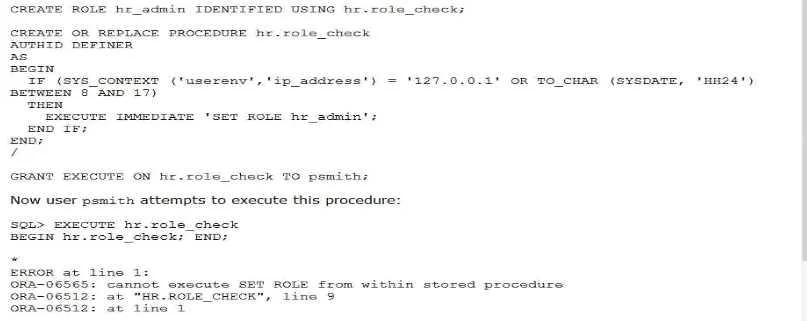
A DBA user created and configured this secure application role: Why does the error occur?
The correct answer is D. The HR_ADMIN role must be granted to user PSMITH. Option D is correct because in Oracle, a secure application role (created with IDENTIFIED USING schema.procedure) must still be explicitly granted to the user before the role-verification procedure can activate it. Without GRANT HR_ADMIN TO PSMITH, the procedure has nothing to…
Question
A DBA user created and configured this secure application role:
Why does the error occur?
Exhibit
Options
- AUser psmith Is connecting outside of the SYSDATE specified.
- BThe set hole hr_admin stuternent must be executed with the dbms. session. set_role procedure.
- Cuser psmith is connecting remotely.
- DThe HR_ADMIN role must be granted to user PSMITH.
- EThe HR.ROLE_CHECK procedure must be created with the AUTHID CURRENT_USERR clause.
- FThe HR.ROLE_CHECK procedure must be created without the AUTHID clause.
How the community answered
(24 responses)- A8% (2)
- D75% (18)
- E4% (1)
- F13% (3)
Explanation
Option D is correct because in Oracle, a secure application role (created with IDENTIFIED USING schema.procedure) must still be explicitly granted to the user before the role-verification procedure can activate it. Without GRANT HR_ADMIN TO PSMITH, the procedure has nothing to enable - Oracle cannot set a role for a user who was never granted that role.
Why the distractors are wrong:
- A - A time-based check in the procedure would silently skip role activation, not necessarily throw an error; more importantly, the question implies the error is a grant/privilege issue.
- B -
DBMS_SESSION.SET_ROLEis actually the correct mechanism inside a secure role procedure; regularSET ROLEcannot directly enable a secure application role. - C - Remote connections do not inherently prevent secure application roles from functioning.
- E -
AUTHID CURRENT_USER(invoker's rights) would be harmful here, as the calling user may lack privileges needed by the procedure; the default definer's rights is preferred. - F - Omitting the
AUTHIDclause defaults toAUTHID DEFINER, which is actually correct for this use case - so this option describes the right behavior, not the problem.
Memory tip: Think of a secure application role as a locked door - the procedure is the key, but the user still needs to be on the guest list (GRANT) before the key works.
Topics
Community Discussion
No community discussion yet for this question.