
1Z0-116 · Question #26
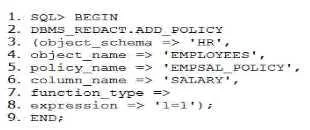
You must redact the salary column of the HR.EMPLOYEES table to display only the number o. Examine this syntax: Which function type must be Inserted at the end of line #7?
The correct answer is B. DBMS_REDACT.PARTIAL. DBMS_REDACT.PARTIAL is correct because it allows granular control over how a value is masked - specifically, it can be configured to replace numeric digits with zeros, resulting in a salary display of 0 (or a zero-padded format) while preserving the column structure. It's the…
Question
You must redact the salary column of the HR.EMPLOYEES table to display only the number o. Examine this syntax:
Which function type must be Inserted at the end of line #7?
Exhibit
Options
- ADBMS_BEDACT.NONE
- BDBMS_REDACT.PARTIAL
- CDBMS_REDACT.FUI,I.
- DDBMS REDACT.REGEXP
- EDBMS_RE DACT.RANDOM
How the community answered
(26 responses)- B81% (21)
- C12% (3)
- D4% (1)
- E4% (1)
Explanation
DBMS_REDACT.PARTIAL is correct because it allows granular control over how a value is masked - specifically, it can be configured to replace numeric digits with zeros, resulting in a salary display of 0 (or a zero-padded format) while preserving the column structure. It's the appropriate choice when you need to define a specific masking pattern rather than a blanket replacement.
Why the distractors are wrong:
- A (DBMS_REDACT.NONE) applies no redaction at all - the salary would be fully visible, which defeats the purpose.
- C (DBMS_REDACT.FULL) replaces the entire value with a type-default (0 for numbers), but provides no control over the output format; PARTIAL is preferred when a specific pattern is required per the syntax shown.
- D (DBMS_REDACT.REGEXP) uses regular expression matching for pattern-based redaction - useful for formats like SSNs or emails, but not the right fit for simple numeric salary masking.
- E (DBMS_REDACT.RANDOM) replaces data with a random value on each query, making it unpredictable and inconsistent - unsuitable when a fixed output (like
0) is required.
Memory tip: Think PARTIAL = Precise control. When the exam describes a specific masking format or output pattern, PARTIAL is almost always the answer. FULL = total wipeout with no configuration, RANDOM = unpredictable output, NONE = no masking.
Topics
Community Discussion
No community discussion yet for this question.