
1Z0-116 · Question #24
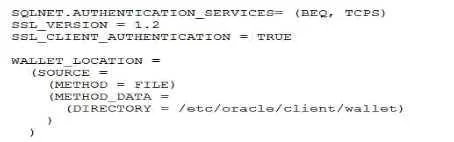
Examine this sqlnet.ora file used by a client application: Which three are found in the wallet specified by the directory parameter?
The correct answer is D. the private key of the client application F. the user certificate used to uniquely Identify the client application G. the trusted certificates of the Certification Authority. In Oracle SSL/TLS authentication, the sqlnet.ora wallet directory points to the client-side Oracle Wallet, which holds everything the client needs to establish its own identity and verify who it's connecting to. A client wallet must contain its own private key (D) to…
Question
Examine this sqlnet.ora file used by a client application:
Which three are found in the wallet specified by the directory parameter?
Exhibit
Options
- Athe private key of the database service
- Bthe trusted certificates of the database service
- Cthe user certificate used to uniquely Identify the database service
- Dthe private key of the client application
- Ethe username, password, and service name required to connect to the database
- Fthe user certificate used to uniquely Identify the client application
- Gthe trusted certificates of the Certification Authority
How the community answered
(37 responses)- A5% (2)
- B14% (5)
- C5% (2)
- D73% (27)
- E3% (1)
Explanation
In Oracle SSL/TLS authentication, the sqlnet.ora wallet directory points to the client-side Oracle Wallet, which holds everything the client needs to establish its own identity and verify who it's connecting to. A client wallet must contain its own private key (D) to participate in the SSL handshake, its own user certificate (F) so the server can authenticate it, and the trusted CA certificates (G) so the client can verify the server's identity against a known authority.
Options A, B, and C are wrong because the database server's private key and certificate live in the server-side wallet, not the client's - each party holds its own credentials. Option E describes the Oracle External Password Store feature (credentials stored via mkstore), which is a different wallet use case unrelated to the SSL certificate store referenced here.
Memory tip: Think of the client wallet as "My key, my ID, my trust list" - the private key proves you can sign, the user certificate proves who you are, and the CA certificates define who you trust. If it belongs to the server, it belongs in the server's wallet, not yours.
Topics
Community Discussion
No community discussion yet for this question.