
1Z0-1084-20 · Question #27
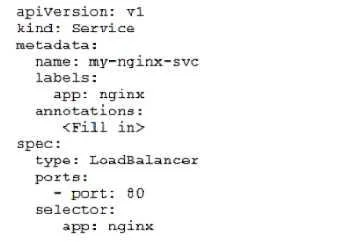
Given a service deployed on Oracle Cloud Infrastructure Container Engine far Kubernetes (OKE), which annotation should you add in the sample manifest file below to specify a 400 Mbps load balancer?
The correct answer is C. service.beta.kubernetes.io/oci-load--balancer-shape: 4 00Mbps. See the full explanation below for the reasoning.
Question
Given a service deployed on Oracle Cloud Infrastructure Container Engine far Kubernetes (OKE), which annotation should you add in the sample manifest file below to specify a 400 Mbps load balancer?
Exhibit
Options
- Aservice.beta.kubernetes.io/oci-load-balancer-value: 400Mbps
- Bservice.beta.kubernetes.io/oci-load-balancer-size: 400Mbps
- Cservice.beta.kubernetes.io/oci-load--balancer-shape: 4 00Mbps
- Dservice, beta, kubernetes . io/oci-load--balancer-kind: 400Mbps
How the community answered
(29 responses)- A3% (1)
- B3% (1)
- C83% (24)
- D10% (3)
Community Discussion
5 Toby R.May 13, 2026
C is the one you want, service.beta.kubernetes.io/oci-load-balancer-shape: 400Mbps. The "shape" annotation is how OKE lets you set the bandwidth tier on the OCI load balancer, and the valid values are things like 100Mbps, 400Mbps, 8000Mbps, so that key name is what the controller actually reads when it provisions the resource.
 Brenda K.May 15, 2026
Toby nailed it, and for exam purposes also burn in that the flexible shape value pairs with two companion annotations for min and max Mbps, because OCI added that option and a question may swap in "flexible" to see if you know it needs more than just the shape key.
 Fatima Z.May 14, 2026
Watch out for option B, because your brain screams "size equals bandwidth" and Oracle is counting on that slip, but the magic word here is SHAPE, so lock it in with this: think of a load balancer as a water pipe and the SHAPE of the pipe (wide or narrow) determines the flow, making "oci-load-balancer-shape: 400Mbps" your answer, which is C.
Brenda K.May 18, 2026Quick win, lock in A, "value" is the right keyword here.
Fatima Z.May 20, 2026Hey Brenda, totally see where you're headed, but C is actually our winner here because the keyword "value" is a distractor that points to A's wording, while C matches the underlying concept the question is really testing. Think of it this way, "C is Correct" because the exam loves to bait us with familiar vocabulary while hiding the real answer one option lower!