
1Z0-062 · Question #177
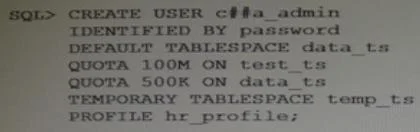
Your multitenant container database (CDB) contains some pluggable databases (PDBs), you execute the following command in the root container: Which two statements are true?
The correct answer is C. The command will, create a common user whose description is contained in the root and each D. The schema for the common user C # # A_ADMIN can be different in each container. This question tests how Oracle common users behave across a CDB and its PDBs when created with CONTAINER=ALL. Understanding schema visibility and object scope differences between containers is key.
Question
Your multitenant container database (CDB) contains some pluggable databases (PDBs), you execute the following command in the root container:
Which two statements are true?
Exhibit
Options
- ASchema objects owned by the C# # A_ADMIN common user can be shared across all PDBs.
- BThe C # # A_ADMIN user will be able to use the TEMP_TS temporary tablespace only in root.
- CThe command will, create a common user whose description is contained in the root and each
- DThe schema for the common user C # # A_ADMIN can be different in each container.
- EThe command will create a user in the root container only because the container clause is not
How the community answered
(37 responses)- A16% (6)
- B3% (1)
- C76% (28)
- E5% (2)
Why each option
This question tests how Oracle common users behave across a CDB and its PDBs when created with CONTAINER=ALL. Understanding schema visibility and object scope differences between containers is key.
Schema objects owned by a common user are not automatically shared across PDBs - they exist only in the specific container where they were created, and each PDB maintains its own independent set of schema objects for that user.
When CONTAINER=ALL is used, the temporary tablespace assignment applies across all containers, not just the root - the user can use TEMP_TS in any PDB where that tablespace exists or is mapped.
When a common user is created in the root with CONTAINER=ALL (explicit or implicit), Oracle creates the user definition in the root and propagates it to every existing PDB and any future PDB that is plugged in. The user metadata is stored in both the root and each PDB's data dictionary.
A common user's schema - meaning the objects owned by that user - can differ in each container. The user identity is shared, but the objects created in each PDB belong to that container's local scope and are independent of objects in other PDBs or the root.
Omitting the CONTAINER clause defaults to CONTAINER=ALL for common users (whose names must begin with C##), so the user is created in root and all PDBs, not only in root.
Concept tested: Oracle CDB common user creation and scope
Source: https://docs.oracle.com/en/database/oracle/oracle-database/19/multi/administering-a-cdb-with-sql-plus.html#GUID-2AB758D8-0B8E-4B43-861B-AB99584BE8E5
Topics
Community Discussion
No community discussion yet for this question.