
1Z0-061 · Question #9
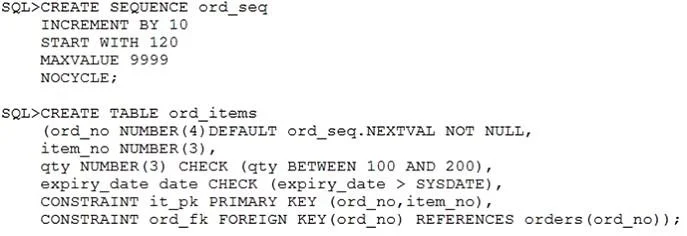
Evaluate the following SQL commands: The command to create a table fails. Identify the two reasons for the SQL statement failure?
The correct answer is A. You cannot use SYSDATE in the condition of a check constraint. C. You cannot use the NEXTVAL sequence value as a default value for a column. CHECK Constraint The CHECK constraint defines a condition that each row must satisfy. The condition can use the same constructs as the query conditions, with the following exceptions: SYSDATE, UID, USER, and USERENV functions Queries that refer to other values in other rows A…
Question
Evaluate the following SQL commands:
The command to create a table fails. Identify the two reasons for the SQL statement failure?
Exhibit
Options
- AYou cannot use SYSDATE in the condition of a check constraint.
- BYou cannot use the BETWEEN clause in the condition of a check constraint.
- CYou cannot use the NEXTVAL sequence value as a default value for a column.
- DYou cannot use ORD_NO and ITEM_NO columns as a composite primary key because ORD_NO is
How the community answered
(51 responses)- A84% (43)
- B10% (5)
- D6% (3)
Explanation
CHECK Constraint The CHECK constraint defines a condition that each row must satisfy. The condition can use the same constructs as the query conditions, with the following exceptions: SYSDATE, UID, USER, and USERENV functions Queries that refer to other values in other rows A single column can have multiple CHECK constraints that refer to the column in its definition. There is no limit to the number of CHECK constraints that you can define on a column. CHECK constraints can be defined at the column level or table level. CREATE TABLE employees Salary NUMBER(8, 2) CONSTRAINT emp_salary_min CHECK (salary > 0),
Topics
Community Discussion
No community discussion yet for this question.