
1Z0-061 · Question #272
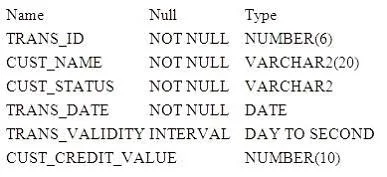
Examine the structure proposed for the TRANSACTIONS table: Which two statements are true regarding the storage of data in the above table structure? (Choose two.)
The correct answer is B. The CUST_CREDIT_VALUE column would allow storage of positive and negative integers. D. The CUST_STATUS column would allow storage of data up to the maximum VARCHAR2 size of. Explanation:B: The NUMBER datatype stores fixed and floating-point numbers. Numbers of virtually any magnitude can be stored and are guaranteed portable among different systems operating Oracle, up to 38 digits of precision. The following numbers can be stored in a NUMBER…
Question
Examine the structure proposed for the TRANSACTIONS table:
Which two statements are true regarding the storage of data in the above table structure? (Choose two.)
Exhibit
Options
- AThe TRANS_DATE column would allow storage of dates only in the dd-mon-yyyy format.
- BThe CUST_CREDIT_VALUE column would allow storage of positive and negative integers.
- CThe TRANS_VALIDITY column would allow storage of a time interval in days, hours, minutes, and
- DThe CUST_STATUS column would allow storage of data up to the maximum VARCHAR2 size of
How the community answered
(41 responses)- A12% (5)
- B80% (33)
- C7% (3)
Explanation
Explanation:B: The NUMBER datatype stores fixed and floating-point numbers. Numbers of virtually any magnitude can be stored and are guaranteed portable among different systems operating Oracle, up to 38 digits of precision. The following numbers can be stored in a NUMBER column: Positive numbers in the range 1 x 10-130 to 9.99...9 x 10125 with up to 38 significant digits Negative numbers from -1 x 10-130 to 9.99...99 x 10125 with up to 38 significant digits Zero Positive and negative infinity (generated only by importing from an Oracle Version 5 database) D: The VARCHAR2 datatype stores variable-length character strings. When you create a table with a VARCHAR2 column, you specify a maximum string length (in bytes or characters) between 1 and 4000 bytes for the VARCHAR2 column. An interval literal specifies a period of time, and Oracle supports two types of interval literals: YEAR_TO_MONTH and DAY TO SECOND. For DAY TO SECOND, you can specify these differences in terms in terms of days, hours, minutes, and seconds. DAY TO SECOND contains a leading field and may contain an optional trailing field. If trailing field is specified it must be less significant than the leading field. For example, INTERVAL MINUTE TO DAY is not valid. A DAY TO MINUTE interval considers an interval of days to the nearest minute.
Topics
Community Discussion
No community discussion yet for this question.