
1Z0-061 · Question #176
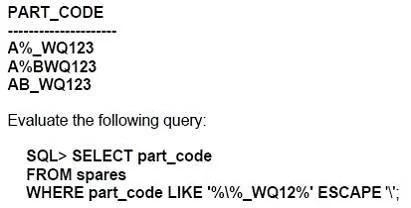
The PART_CODE column in the SPARES table contains the following list of values: Which statement is true regarding the outcome of the above query?
The correct answer is D. It displays only the values A%_WQ123 and A%BWQ123. Combining Wildcard Characters The % and _ symbols can be used in any combination with literal characters. The example in the slide displays the names of all employees whose last names have the letter "o" as the second ESCAPE Identifier When you need to have an exact match for…
Question
The PART_CODE column in the SPARES table contains the following list of values:
Which statement is true regarding the outcome of the above query?
Exhibit
Options
- AIt produces an error.
- BIt displays all values.
- CIt displays only the values A%_WQ123 and AB_WQ123 .
- DIt displays only the values A%_WQ123 and A%BWQ123 .
- EIt displays only the values A%BWQ123 and AB_WQ123.
How the community answered
(30 responses)- A17% (5)
- B7% (2)
- C3% (1)
- D70% (21)
- E3% (1)
Explanation
Combining Wildcard Characters The % and _ symbols can be used in any combination with literal characters. The example in the slide displays the names of all employees whose last names have the letter "o" as the second ESCAPE Identifier When you need to have an exact match for the actual % and _ characters, use the ESCAPE identifier. This option specifies what the escape character is. If you want to search for strings that contain SA_, you can use the following SQL statement: SELECT employee_id, last_name, job_id FROM employees WHERE job_id LIKE '%SA_%' ESCAPE '';
Topics
Community Discussion
No community discussion yet for this question.