1Z0-061 · Question #102
Which two statements are true regarding working with dates? (Choose two.)
The correct answer is A. The default internal storage of dates is in the numeric format B. The RR date format automatically calculates the century from the SYSDATE function but allows. Working with Dates The Oracle Database stores dates in an internal numeric format, representing the century, year, month, day, hours, minutes, and seconds. The default display and input format for any date is DD-MON-RR. The RR date format is similar to the YY element, but you…
Question
Which two statements are true regarding working with dates? (Choose two.)
Exhibit
Options
- AThe default internal storage of dates is in the numeric format
- BThe RR date format automatically calculates the century from the SYSDATE function but allows
- CThe default internal storage of dates is in the character format
- DThe RR date format automatically calculates the century from the SYSDATE function and does not
How the community answered
(31 responses)- A84% (26)
- C10% (3)
- D6% (2)
Explanation
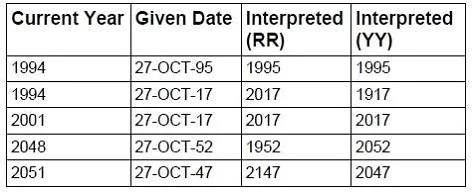
Working with Dates The Oracle Database stores dates in an internal numeric format, representing the century, year, month, day, hours, minutes, and seconds. The default display and input format for any date is DD-MON-RR. The RR date format is similar to the YY element, but you can use it to specify different centuries. Use the RR date format element instead of YY so that the century of the return value varies according to the specified two digit year and the last two digits of the current year. The table in the slide summarizes the behavior of the RR element. Note the values shown in the last two rows of the above table. As we approach the middle of the century, then the RR behavior is probably not what you want. This data is stored internally as follows: CENTURY YEAR MONTH DAY HOUR MINUTE SECOND 19 87 06 17 17 10 43
Topics
Community Discussion
No community discussion yet for this question.
