
1Z0-060 · Question #54
What is the effect of specifying the "ENABLE PLUGGABLE DATABASE" clause in a "CREATE DATABASE" statement?
The correct answer is B. It will create a CDB with root opened and seed read only. *The CREATE DATABASE ... ENABLE PLUGGABLE DATABASE SQL statement creates a new CDB. If you do not specify the ENABLE PLUGGABLE DATABASE clause, then the newly created database is a non-CDB and can never contain PDBs. Along with the root (CDB$ROOT), Oracle Database automatically…
Question
What is the effect of specifying the "ENABLE PLUGGABLE DATABASE" clause in a "CREATE DATABASE" statement?
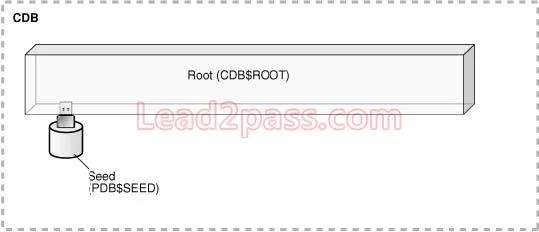
Exhibit
Options
- AIt will create a multitenant container database (CDB) with only the root opened.
- BIt will create a CDB with root opened and seed read only.
- CIt will create a CDB with root and seed opened and one PDB mounted.
- DIt will create a CDB that must be plugged into an existing CDB.
- EIt will create a CDB with root opened and seed mounted.
How the community answered
(20 responses)- B90% (18)
- C5% (1)
- D5% (1)
Explanation
*The CREATE DATABASE ... ENABLE PLUGGABLE DATABASE SQL statement creates a new CDB. If you do not specify the ENABLE PLUGGABLE DATABASE clause, then the newly created database is a non-CDB and can never contain PDBs. Along with the root (CDB$ROOT), Oracle Database automatically creates a seed PDB (PDB$SEED). The following graphic shows a newly created CDB: Rather than constructing the data dictionary tables that define an empty PDB from scratch, and then populating its Obj$ and Dependency$ tables, the empty PDB is created when the CDB is created. (Here, we use empty to mean containing no customer-created artifacts.) It is referred to as the seed PDB and has the name PDB$Seed. Every CDB non-negotiably contains a seed PDB; it is non-negotiably always open in read-only mode. This has no conceptual significance; rather, it is just an optimization device. The create PDB operation is implemented as a special case of the clone PDB operation.
Topics
Community Discussion
No community discussion yet for this question.