
1Z0-060 · Question #228
Your database supports an online transaction processing (OLTP) workload on an SMP machine. The database is stored in ASM. Examine these initialization parameters. Applications are update intensive…
The correct answer is A. decrease the size of the buffer cache E. configure I/O slaves for the DBWR process. Free buffer waits occur when server processes cannot find a free (clean) buffer because DBWR is not flushing dirty buffers to disk fast enough. Since increasing the buffer cache temporarily helped but the waits returned, the root problem is DBWR write throughput, not cache…
Question
Exhibit
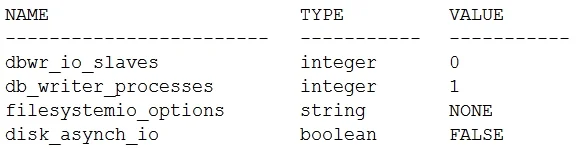
Options
- Adecrease the size of the buffer cache
- Bconfigure asynchronous I/O
- Cmodifying the ASM disk for the database to use high redundancy
- Dconfigure multiple DBWn processes
- Econfigure I/O slaves for the DBWR process
How the community answered
(45 responses)- A67% (30)
- B4% (2)
- C9% (4)
- D20% (9)
Explanation
Free buffer waits occur when server processes cannot find a free (clean) buffer because DBWR is not flushing dirty buffers to disk fast enough. Since increasing the buffer cache temporarily helped but the waits returned, the root problem is DBWR write throughput, not cache capacity. Configuring I/O slaves for DBWR (E) allows the single DBWR process to parallelize its disk writes, directly improving write throughput - this is the primary fix when async I/O is not fully utilized at the database layer. Decreasing the buffer cache (A) is counterintuitive but effective: a smaller cache forces DBWR to write dirty buffers more frequently in smaller batches rather than accumulating a large write backlog, preventing the burst I/O that causes waits. Option B (async I/O) adds less value because ASM already leverages async I/O at the storage layer. Option D (multiple DBWn processes) would also help on SMP but is not chosen here since I/O slaves address the specific batch-write bottleneck. Option C (ASM high redundancy) increases write amplification and would worsen I/O pressure.
Topics
Community Discussion
No community discussion yet for this question.