
1Z0-060 · Question #218
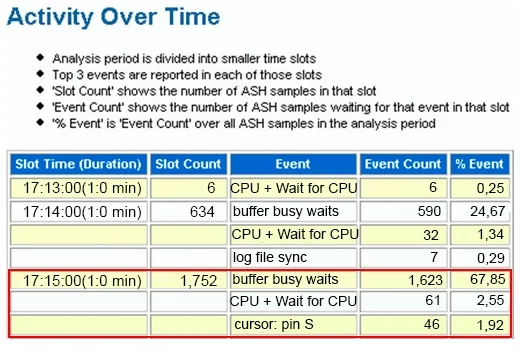
Examine the portion of this Active Session History (ASH) report that is marked with a red rectangle: Which two inferences can be drawn from the report?
The correct answer is A. Sessions attempting to modify blocks images in the buffer cache are waiting while other sessions C. Sessions are waiting for writes of modified block images in the buffer cache to complete. This ASH report shows wait events related to modified block images in the Oracle buffer cache, indicating contention on dirty blocks between sessions.
Question
Examine the portion of this Active Session History (ASH) report that is marked with a red rectangle:
Which two inferences can be drawn from the report?
Exhibit
Options
- ASessions attempting to modify blocks images in the buffer cache are waiting while other sessions
- BSessions are waiting to find free buffers in the buffer cache.
- CSessions are waiting for writes of modified block images in the buffer cache to complete
- DSessions are attempting to read blocks images in the buffer cache are waiting while other sessions
- ESessions attempting to read blocks images in the buffer cache are waiting while other sessions are
How the community answered
(25 responses)- A68% (17)
- B4% (1)
- D8% (2)
- E20% (5)
Why each option
This ASH report shows wait events related to modified block images in the Oracle buffer cache, indicating contention on dirty blocks between sessions.
Buffer busy waits occur when a session tries to modify a block that another session currently holds a pin on; sessions modifying block images must wait while the competing session completes its operation on that buffer.
Free buffer waits indicate the buffer cache has no available slots and DBWR cannot keep up with dirty block production, which is a different wait class from contention on already-modified block images.
Write complete waits occur when DBWR has been asked to flush a dirty block to disk and a foreground session must pause until that write finishes before it can reuse or access that buffer, directly confirming waits for writes of modified block images.
Waiting to read block images describes a read I/O wait (db file sequential/scattered read), not contention on modified dirty buffers already in the cache.
Sessions waiting to read blocks while others hold pins is a read-side buffer busy scenario, whereas the ASH data shown points specifically to write-side or modification-side contention on dirty blocks.
Concept tested: Oracle ASH buffer cache wait event analysis
Source: https://docs.oracle.com/en/database/oracle/oracle-database/19/tgdba/instance-tuning-using-performance-views.html
Topics
Community Discussion
No community discussion yet for this question.