
1Z0-060 · Question #111
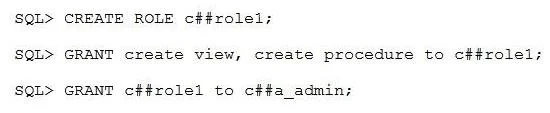
In your multitenant container database (CDB) containing same pluggable databases (PDBs), you execute the following commands in the root container: Which two statements are true?
The correct answer is A. The C # # ROLE1 role is created in the root database and all the PDBs. C. Privileges are granted to the C##A_ADMIN user only in the root database. You can include the CONTAINER clause in several SQL statements, such as the CREATE USER, ALTER USER, CREATE ROLE, GRANT, REVOKE, and ALTER SYSTEM statements. * CREATE ROLE with CONTAINER (optional) clause /CONTAINER = ALL Creates a common role. / CONTAINER = CURRENT Creates a…
Question
In your multitenant container database (CDB) containing same pluggable databases (PDBs), you execute the following commands in the root container:
Which two statements are true?
Exhibit
Options
- AThe C # # ROLE1 role is created in the root database and all the PDBs.
- BThe C # # ROLE1 role is created only in the root database because the container clause is not used.
- CPrivileges are granted to the C##A_ADMIN user only in the root database.
- DPrivileges are granted to the C##A_ADMIN user in the root database and all PDBs.
- EThe statement for granting a role to a user fails because the CONTAINER clause is not used.
How the community answered
(62 responses)- A79% (49)
- B5% (3)
- D13% (8)
- E3% (2)
Explanation
*You can include the CONTAINER clause in several SQL statements, such as the CREATE USER, ALTER USER, CREATE ROLE, GRANT, REVOKE, and ALTER SYSTEM statements. * * CREATE ROLE with CONTAINER (optional) clause /CONTAINER = ALL Creates a common role. / CONTAINER = CURRENT Creates a local role in the current PDB.
Topics
Community Discussion
No community discussion yet for this question.