
1Z0-058 · Question #12
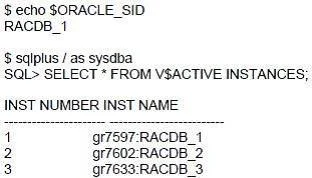
You are managing a policy-managed database called RACDB. Examine the output given below: You used these commands to add the service erp: Which statement is true regarding the srvctl stop instance…
The correct answer is A. It will shut down the racdb_1 instance and the ERP service running on node gr7597. Stops instances and stops any services running on specified instances, unless you specify the -f option. If you specify -f, then the services fail over to an available instance when the instance Syntax and Options Use the srvctl stop instance command with the following syntax…
Question
You are managing a policy-managed database called RACDB. Examine the output given below:
You used these commands to add the service erp:
Which statement is true regarding the srvctl stop instance command?
Exhibit
Options
- AIt will shut down the racdb_1 instance and the ERP service running on node gr7597.
- BIt will shut down the racdb_1 instance, and the ERP service will fail over to an available Instance.
- CIt will shut down the racdb_1 instance, but the ERP service will keep running on node gr7597
- DIt will shut down the racdb_1 instance and the ERP service running on ih.il Instance However
- EIt will shut down the racdb_1 instance and stop the ERP service on all the nodes
How the community answered
(51 responses)- A76% (39)
- B8% (4)
- C2% (1)
- D4% (2)
- E10% (5)
Explanation
Stops instances and stops any services running on specified instances, unless you specify the -f option. If you specify -f, then the services fail over to an available instance when the instance Syntax and Options Use the srvctl stop instance command with the following syntax: srvctl stop instance -d db_unique_name {[-n node_name]|[-i "instance_name_list"]} [-o stop_options] [-f] Oracle Real Application Clusters Administration and Deployment Guide
Topics
Community Discussion
No community discussion yet for this question.