
1Z0-052 · Question #49
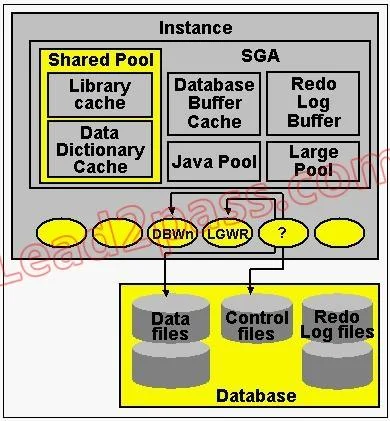
View the Exhibit and identify the component marked with a question mark.
The correct answer is A. Checkpoint (CKPT). The component marked in the exhibit is the Checkpoint process (CKPT), a core Oracle background process responsible for triggering write operations and updating file headers.
Question
View the Exhibit and identify the component marked with a question mark.
Exhibit
Options
- ACheckpoint (CKPT)
- BProcess Monitor (PMON)
- CArchiver Processes (ARcn)
- DRecoverer Process (RECO)
- EMemory Manager Process (MMAN)
How the community answered
(24 responses)- A96% (23)
- E4% (1)
Why each option
The component marked in the exhibit is the Checkpoint process (CKPT), a core Oracle background process responsible for triggering write operations and updating file headers.
The Checkpoint process (CKPT) signals the Database Writer (DBWn) to flush dirty buffers from the buffer cache to data files, then updates both the control file and data file headers with the current checkpoint SCN. This ensures database recoverability by keeping physical files synchronized with in-memory changes, making it identifiable in architecture diagrams by its role bridging the SGA buffer cache and on-disk structures.
PMON (Process Monitor) monitors and cleans up resources left by failed user processes, such as releasing locks and rolling back uncommitted transactions.
ARCn (Archiver) copies filled online redo log files to archive destinations and plays no role in checkpoint signaling or file header updates.
RECO (Recoverer) resolves in-doubt transactions that arise from network or system failures in distributed database environments.
MMAN (Memory Manager) dynamically manages the sizes of SGA components under Automatic Shared Memory Management and is unrelated to checkpoint operations.
Concept tested: Oracle CKPT background process role in database architecture
Source: https://docs.oracle.com/cd/E11882_01/server.112/e40402/bgprocesses.htm
Topics
Community Discussion
No community discussion yet for this question.