
1Z0-052 · Question #151
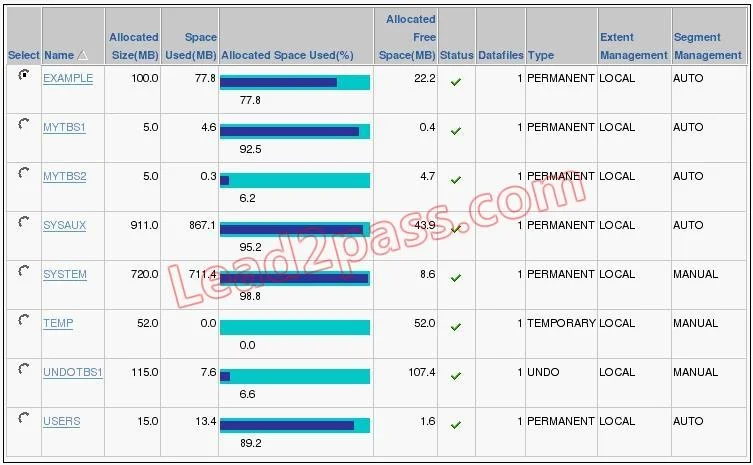
See the Exhibit. Which statements are true regarding the USERS tablespace? (Choose all that apply.)
The correct answer is A. A bitmap is used to record free extents B. Free extents information is managed within the tablespace. A locally managed tablespace uses a bitmap stored within the tablespace's own data files to track free and used extents, bypassing the data dictionary entirely.
Question
See the Exhibit. Which statements are true regarding the USERS tablespace? (Choose all that apply.)
Exhibit
Options
- AA bitmap is used to record free extents
- BFree extents information is managed within the tablespace
- CFree extents information is managed in the SYSAUX tablespace
- DThe data dictionary tables are updated when extents are allocated or deallocated
How the community answered
(52 responses)- A90% (47)
- C6% (3)
- D4% (2)
Why each option
A locally managed tablespace uses a bitmap stored within the tablespace's own data files to track free and used extents, bypassing the data dictionary entirely.
Locally managed tablespaces record free and allocated extents using a bitmap stored in the tablespace's own data file headers, eliminating contention on dictionary tables.
Because the bitmap resides within the tablespace data files themselves, free extent information is self-managed inside the tablespace rather than in any central repository.
Free extent tracking in a locally managed tablespace resides within the tablespace's own data file headers, not in SYSAUX, which stores auxiliary schema objects such as AWR data and optimizer statistics.
Updating data dictionary tables on extent allocation and deallocation is characteristic of dictionary-managed tablespaces; locally managed tablespaces bypass the data dictionary for this purpose entirely.
Concept tested: Locally managed tablespace bitmap extent tracking
Source: https://docs.oracle.com/en/database/oracle/oracle-database/19/admin/managing-tablespaces.html
Topics
Community Discussion
No community discussion yet for this question.