
1Z0-052 · Question #142
View the Exhibit and examine the setting for a table. Which statement is true about the PCTFREE setting for the table?
The correct answer is B. It sets the minimum percentage of a data block to be reserved as free space before the server prevents. PCTFREE defines the minimum percentage of a data block that Oracle reserves as free space to accommodate future row updates. Once a block's free space reaches the PCTFREE threshold, Oracle stops inserting new rows into that block.
Question
View the Exhibit and examine the setting for a table. Which statement is true about the PCTFREE setting for the table?
Exhibit
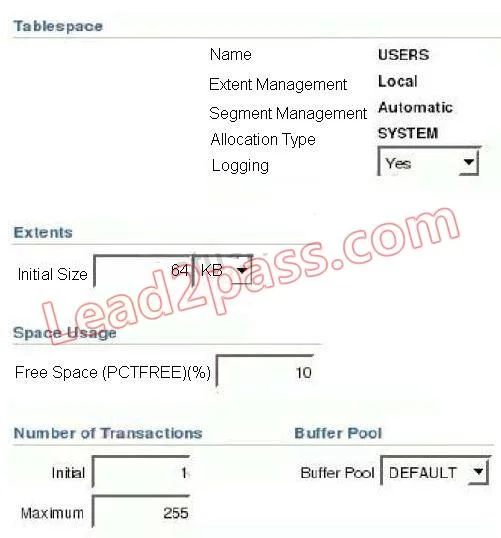
Options
- AIt sets the minimum percentage of a data block to be reserved to contain chained rows from other blocks.
- BIt sets the minimum percentage of a data block to be reserved as free space before the server prevents
- CIt sets the minimum percentage of a data block to be reserved to contain the bitmap used to maintain
- DIt sets the minimum percentage of a block that can be used for row data plus overhead before new rows
How the community answered
(36 responses)- B92% (33)
- C6% (2)
- D3% (1)
Why each option
PCTFREE defines the minimum percentage of a data block that Oracle reserves as free space to accommodate future row updates. Once a block's free space reaches the PCTFREE threshold, Oracle stops inserting new rows into that block.
Chained rows result from rows that are too large for a single block and span multiple blocks; PCTFREE does not reserve space for chained row piece pointers from other blocks.
PCTFREE reserves a defined percentage of each data block so that UPDATE statements which increase row size have space to grow without causing row migration or chaining. When a block fills to the point where only PCTFREE percent of space remains, the Oracle server stops placing new rows into that block and marks it unavailable for inserts. This mechanism protects write performance by reducing the need for row migration across blocks.
PCTFREE has no involvement with bitmap structures; bitmaps in Oracle are associated with bitmap indexes or the bitmap space management used in locally managed tablespaces.
This description more accurately reflects PCTUSED, which defines the minimum percentage of used space that must be reached after rows are deleted before Oracle re-adds the block to the freelist for new row inserts.
Concept tested: Oracle block space management parameter PCTFREE
Source: https://docs.oracle.com/en/database/oracle/oracle-database/19/admin/managing-tables.html
Topics
Community Discussion
No community discussion yet for this question.