nerdexam
Oracle

1Z0-050 · Question #99

View the Exhibit to examine the details for an incident. Which statement is true regarding the status of the incident?

The correct answer is D. The data collection for the incident is complete and the incident can be packaged and sent to. See the full explanation below for the reasoning.

Question

View the Exhibit to examine the details for an incident. Which statement is true regarding the status of the incident?

Exhibit
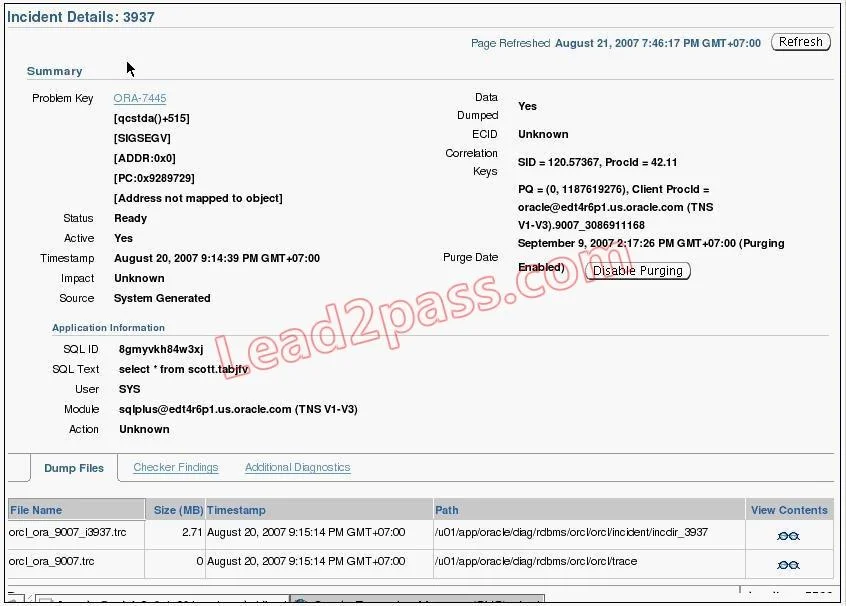
1Z0-050 question #99 exhibit

Options

  • AThe DBA is working on the incident and prefers that the incident be kept in the ADR.
  • BThe incident is now in the Done state and the ADR can select the incident to be purged.
  • CThe incident has been newly created and is in the process of collecting diagnostic information.
  • DThe data collection for the incident is complete and the incident can be packaged and sent to

How the community answered

(43 responses)
  • A
    2% (1)
  • B
    9% (4)
  • C
    7% (3)
  • D
    81% (35)

Community Discussion

8
Yusuf A.Yusuf A.Nov 8, 2025

The answer is D. When the incident status shows that diagnostic data collection has finished, it means the ADR has done its job gathering all the relevant information, and the next logical step is to package that incident and send it to Oracle Support for analysis. My senior walked me through this flow once and pointed out that the "package incident" option only becomes available after collection wraps up, which is the key detail that rules out C and confirms D here.

24
Lena V.Lena V.Dec 9, 2025

D is the pick, and yes, option C is the trap most people fall into because "newly created incident" sounds like it fits an exhibit showing active diagnostic gathering, but that describes the Investigating phase, not what you see when collection wraps up. The exhibit is almost certainly showing the incident in a post-collection state, which means ADRCI can package it and ship it to Oracle Support, and that maps to D even though Oracle cut the option text off mid-sentence (classic exam formatting sloppiness). Know the incident lifecycle cold: created, collecting, packaged, closed. D sits between collecting and closed.

4
Mei-Ling H.Mei-Ling H.Nov 22, 2025

Data collection done means OPEN status, ready to package for Support. Does "OPEN" here confirm collection is finished, or does it just mean a DBA acknowledged it?

3
Prof. SaraProf. SaraNov 22, 2025

OPEN signals the record is acknowledged and in-progress, not that collection is finished, so do not package for Support until you see a terminal status like CLOSED or RESOLVED, which is the handoff trigger most blueprints test on.

0
Prof. SaraProf. SaraNov 4, 2025

Honestly my first read had me circling C, because "newly created" and "collecting diagnostic information" sounds like exactly what you see right after an incident fires, and it is easy to conflate the initial flood-controlled collection phase with an ongoing one. What snapped me back to D is remembering the IPS mnemonic I drill with my students, Collect then Package then Send: once the exhibit shows the collection phase has closed out, the incident is sitting in that ready-to-ship window, which is precisely what D describes, not an active collection and not yet purge-eligible like B would require.

0
Lena V.Lena V.Nov 6, 2025

The Collect-Package-Send sequence is the fastest way to lock in D, and I would add that the exam loves to bait you with C specifically because "newly created" triggers a gut association with incident kickoff, so if you train yourself to look for whether collection is open or closed before you even read the answers, that trap disappears.

0
Samuel O.Samuel O.Nov 30, 2025

Guys I keep coming back to C on this one because every time I have seen a fresh incident hit the ADR in real life, the first thing it does is spin up that collection process to grab dumps, traces, and all the related files before you can even think about packaging anything. The exhibit details line up exactly with that initial capture phase, not something that is already wrapped up or being handed off.

0
Prof. SaraProf. SaraDec 3, 2025

Samuel, the activity you are describing, pulling memory dumps and trace files, is actually Acquisition, which is option D, because that phase specifically covers the forensic capture and imaging of volatile and non-volatile data before anything is packaged or handed off, and what you are thinking of as "collection" is a broader umbrella that Acquisition sits inside of, not a synonym for it.

0
Full 1Z0-050 Practice