
1Z0-034 · Question #115
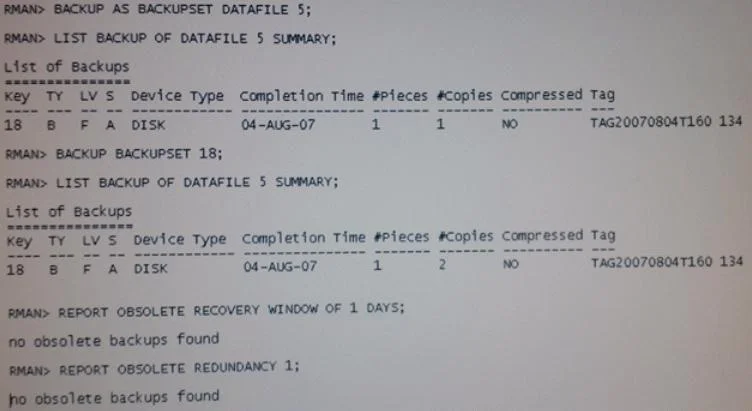
View the Exhibit and examine the RMAN commands. Which statement describes the effect of a backup retention policy on the backup of a backup set?
The correct answer is A. Either all the copies of a backup set are obsolete or none of them are as per the retention policy. See the full explanation below for the reasoning.
Question
View the Exhibit and examine the RMAN commands. Which statement describes the effect of a backup retention policy on the backup of a backup set?
Exhibit
Options
- AEither all the copies of a backup set are obsolete or none of them are as per the retention policy.
- BThe copies of the backup will be reported as obsolete under a redundancy-based backup
- CThe copies of the backup will be reported as obsolete under a recovery window-based backup
- DAll the copies of the backup set are counted as one instance of a backup and will deleted in
How the community answered
(41 responses)- A73% (30)
- B5% (2)
- C15% (6)
- D7% (3)
Community Discussion
5 Anjali D.Jun 26, 2026
Good one to nail down before the exam. The retention policy in RMAN treats all copies of a backup set as a single logical unit, so the policy applies to the set as a whole rather than to individual copies. That means you will never end up in a situation where some copies are considered obsolete while others are not, the entire set either meets the retention criteria or it does not. Answer A is correct because RMAN evaluates redundancy and recovery window requirements against the backup set collectively, so obsolescence is an all-or-nothing determination across every copy. Does anyone in the group have a lab setup where they tested this with CONFIGURE RETENTION POLICY TO REDUNDANCY and actually ran REPORT OBSOLETE afterward? Would be great to see the output side by side with a recovery window policy to confirm the behavior holds in both cases.
 Mei-Ling H.Jun 28, 2026
Good point, but worth flagging that the all-or-nothing rule is specific to backup sets, because image copies are evaluated individually by the retention policy, so if an exam question says "copies" without specifying backup set copies versus image copies, that wording alone can change the correct answer.
Mei-Ling H.Jun 26, 2026Option D is cut off mid-sentence so eliminate it immediately as a distractor that cannot even be evaluated. The key word in option A is "either...or none," which captures exactly how RMAN treats backup set copies under any retention policy, redundancy-based or recovery window-based. B and C each try to limit the rule to only one policy type, which is the trap here, because the all-or-none behavior applies regardless of which retention policy you configure. So A is correct, and the fact that it does not restrict itself to one policy type is precisely what makes it the right answer.
 Marisol N.Jun 26, 2026
D cuts off mid-sentence so ignore it, A is your answer: all-or-nothing obsolescence per policy.
Anjali D.Jun 27, 2026Agreed on A, and worth noting for anyone who got tripped up: the "per policy" qualifier is doing a lot of work there, since the same scenario without a formal policy in place would open the door to partial rollbacks, which is exactly the kind of nuance they love to test.