
1Y0-403 · Question #206
Scenario: A Citrix Architect needs to create a conceptual architecture for a XenApp and XenDesktop environment, on behalf of a retail chain. Based on some initial discussions around the…
The correct answer is E. Single-Site in Citrix Cloud, single on-premises resource location. Explanation/Reference:
Question
Scenario: A Citrix Architect needs to create a conceptual architecture for a XenApp and XenDesktop environment, on behalf of a retail chain. Based on some initial discussions around the organization’s business goals and objectives, the architect has collected the information as shown in the Exhibit. Click the Exhibit button to view the information. Which delivery model should the architect recommend?
Exhibit
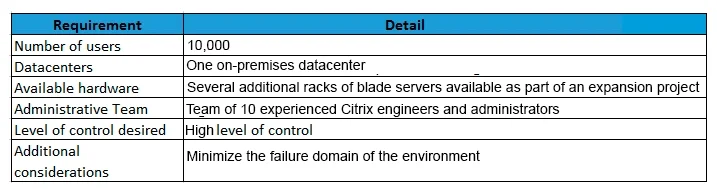
Options
- AMulti-Site, single on-premises datacenter
- BSingle-Site, single-zone, single on-premises datacenter
- CSingle-Site in Citrix Cloud, single public cloud resource location
- DMulti-Site, multiple public cloud resource locations
- ESingle-Site in Citrix Cloud, single on-premises resource location
How the community answered
(46 responses)- A13% (6)
- B2% (1)
- C2% (1)
- D4% (2)
- E78% (36)
Explanation
Explanation/Reference:
Topics
Community Discussion
3 Wesley A.Dec 1, 2025
E is the right call here, and once you see why, it sticks. The exhibit for this question always shows a retail chain with a single headquarters or datacenter footprint, existing on-premises infrastructure they want to keep, and a goal of reducing management overhead without a full rip-and-replace migration. Citrix Cloud gives them the control plane in the cloud so they are not maintaining Delivery Controllers themselves, which directly addresses that management burden concern. The single on-premises resource location fits because their infrastructure is centralized, not spread across regions, so you have no reason to add the complexity of multiple sites or multiple cloud resource locations. Multi-site options like A and D would only make sense if they had geographically distributed datacenters with latency or redundancy requirements driving the design, and the scenario does not give you that. Do not let option C fool you. Moving the resource location to a public cloud when the organization already has on-premises infrastructure they are keeping is an unnecessary migration step that contradicts the conceptual architecture phase, where you are matching the model to what they have, not redesigning their entire footprint. E gives them cloud-managed simplicity with on-premises resource delivery, which is exactly the hybrid sweet spot Citrix Cloud was built for.
 Kemal J.Dec 7, 2025
E is the right call here, and if you picked anything with multiple sites or multiple public cloud locations at the conceptual stage you are solving problems that the exhibit never gave you. Citrix Cloud hosting the control plane means the retail chain's IT team is not babysitting delivery controllers at 2am when someone in accounting can't get to their virtual desktop, and that alone usually sells it for organizations without a deep Citrix bench. The on-premises resource location keeps the VDAs and data where the existing datacenter investment already is, which matters for retail because PCI scope gets ugly fast when you start moving workloads to a public cloud resource location you do not fully control. B would work technically but it puts the full management burden on a retail IT team that probably considers "rebooting the server" an advanced troubleshooting step, so handing the control plane to Citrix Cloud is the smarter starting point before you even touch a CDF trace.
 Hiroshi T.Dec 18, 2025
E is right. Citrix Cloud control plane with on-premises resource location fits a retail chain avoiding full cloud migration.