nerdexam
CIW

1D0-541 · Question #118

A relation for a construction company is shown in the exhibit. Which of the following best defines the relationship between Cust_ID and Cust_Name?

The correct answer is D. Cust_Name is functionally dependent on Cust_ID. See the full explanation below for the reasoning.

Question

A relation for a construction company is shown in the exhibit. Which of the following best defines the relationship between Cust_ID and Cust_Name?

Exhibit
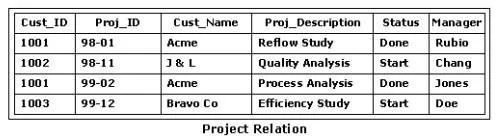
1D0-541 question #118 exhibit

Options

  • ACust_Name is the determinant.
  • BCust_Name is transitively dependent on Cust_ID.
  • CCust_ID is transitively dependent on Cust_Name.
  • DCust_Name is functionally dependent on Cust_ID.

How the community answered

(45 responses)
  • A
    11% (5)
  • B
    2% (1)
  • C
    4% (2)
  • D
    82% (37)

Community Discussion

5
Imani T.Imani T.Jun 27, 2026

D is your answer. Cust_Name is functionally dependent on Cust_ID because for every unique Cust_ID value, there is exactly one corresponding Cust_Name, which is the textbook definition of functional dependency, not transitive dependency (which would require a chain through a third attribute) and not the reverse where Cust_Name drives Cust_ID.

25
Mei-Ling H.Mei-Ling H.Jun 29, 2026

Good explanation, and I will add one thing the exam sometimes tests on top of this, which is that even if Cust_Name happens to be unique in your sample data, uniqueness in the data does not make it a determinant unless the schema enforces it, so Cust_ID -> Cust_Name holds by design, not by coincidence.

0
Fatima Z.Fatima Z.Jun 17, 2026

Option A tries to trip you up because "determinant" sounds important, like it must be the ID, but a determinant is just whatever sits on the LEFT side of the arrow, so Cust_ID is the determinant here, not Cust_Name. B and C are trying to sneak in transitive dependency, which needs a three-step chain like a game of telephone, "A tells B who tells C," and we only have two attributes in this direct relationship. My memory hook is FIND, which stands for Functional dependency Is a Non-chain Dependency, meaning one value points straight at another with no middleman. Since Cust_ID points directly to Cust_Name, Cust_Name is functionally dependent on Cust_ID, and D is your answer.

1
Mei-Ling H.Mei-Ling H.Jun 23, 2026

D is correct here. Functional dependency means one attribute uniquely determines another, so if you know the Cust_ID you can look up exactly one Cust_Name, that is the definition. A is wrong because the determinant is Cust_ID, not Cust_Name, the determinant is the one doing the determining. Transitive dependency in B and C would require a third attribute in the middle, like Cust_ID determines Project_ID and Project_ID determines something else, but there is no middle step between Cust_ID and Cust_Name in a simple two-attribute relationship like this.

0
Imani T.Imani T.Jun 25, 2026

Solid breakdown, and worth adding that the direction thing in A trips people up constantly on the exam because "functional dependency" sounds symmetric but it is strictly one-way, Cust_ID determines Cust_Name and not the reverse.

0
Full 1D0-541 Practice