
117-301 · Question #123
What operating system tools can be used to collect capacity planning data? (Choose two.)
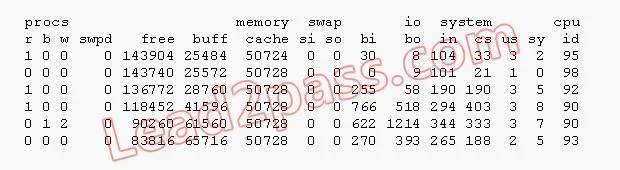
The correct answer is B. vmstat C. iostat. See the full explanation below for the reasoning.
Question
Exhibit
Options
- Alsmod
- Bvmstat
- Ciostat
- Dfuser
How the community answered
(48 responses)- A19% (9)
- B73% (35)
- D8% (4)
Community Discussion
4 Yusuf A.Apr 11, 2026
The correct answers are B (vmstat) and C (iostat). vmstat gives you a snapshot of virtual memory, CPU, and process activity over time, which is exactly what you need when building a picture of where your system resources are going, and iostat shows you disk I/O and CPU utilization stats, so together those two tools are your go-to pair for capacity planning. lsmod just lists loaded kernel modules and fuser tells you which process is using a file or socket, so neither of those helps you trend resource usage.
 Anjali D.Mar 31, 2026
I went with A and C at first because lsmod felt like it fit the "system diagnostics" vibe, but then I remembered lsmod just lists loaded kernel modules and tells you nothing about performance over time, so it is useless for capacity planning. vmstat and iostat are the ones that actually give you the memory, CPU, and I/O throughput data you need to trend and plan capacity, which is why B and C are the pick.
 Lena V.Mar 30, 2026
Saw this exact question, froze, then remembered vmstat and iostat both report resource usage over time. B and C, locked it in, moved on.
Yusuf A.Apr 2, 2026Good call, and what helped me keep the two straight is that vmstat also covers swap and memory pressure, so if a question hints at a memory bottleneck instead of just disk I/O, you know which one to lean on first.